
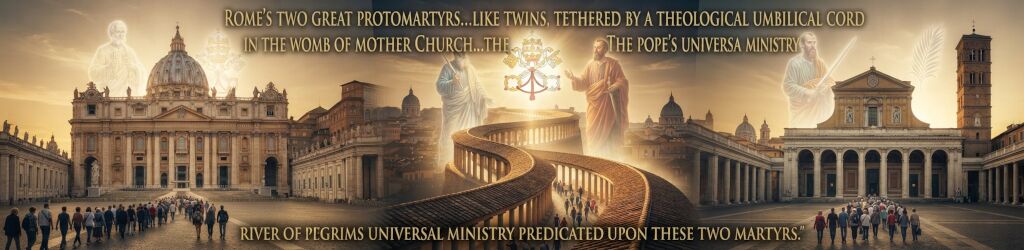
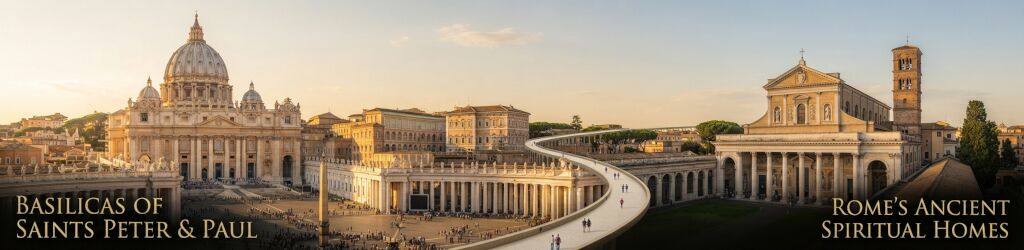
Today’s feast commemorates the dedication of two of the world’s most magnificent churches: Basilicas Of Saints Peter & Paul. The Basilica of St. Peter, the magnificent jewel in the crown of Vatican City, and the Basilica of St. Paul Outside the Walls, located a few miles distant beyond Rome’s ancient walls. To truly appreciate Catholic heritage, exploring the history of Vatican City and understanding the papal basilicas offers profound insight into Christian tradition. Furthermore, you can learn more about local parish life and pilgrimages through resources like sjp2.org.
The Architectural Evolution of St. Peter’s and St. Paul’s
The history of the Basilicas Of Saints Peter & Paul, two sacred structures, spans centuries of architectural evolution, faith, and resilience:
- St. Peter’s Basilica: The present structure was consecrated in 1626 after more than a century of construction, built directly over the tomb of the Apostle Peter. The prior fourth-century Constantinian-age building had grown so decrepit by the early 1500s that priests feared sagging roofs and leaning walls.
- St. Paul Outside the Walls: This ancient basilica was consumed by a mammoth fire in 1823 and rebuilt, with the new church dedicated on December 10, 1854. Its breathtaking classical elegance features a marbled central nave stretching longer than an American football field.
- The Historic Colonnade: For centuries, the two basilicas were linked by a miles-long, roofed colonnade snaking through Rome’s streets, sheltering pilgrims flowing between the shrines.
The Theological Bond of Rome’s Protomartyrs
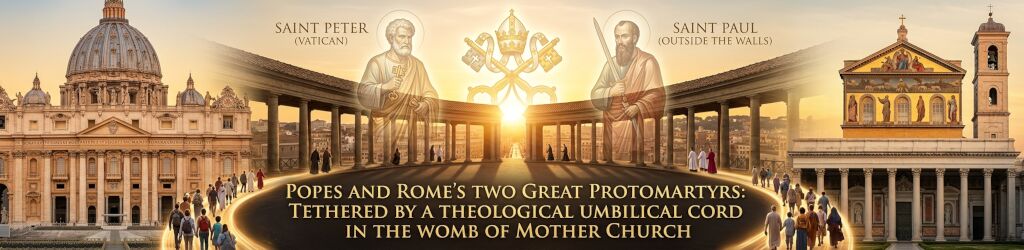
The Basilicas Of Saints Peter & Paul, Rome’s two great protomartyrs were like twins, tethered by a theological umbilical cord in the womb of Mother Church. The pope’s universal ministry was explicitly predicated upon these two martyrs. Rome’s apostolic reputation meant the Bishop of Rome’s headship was not merely symbolic; he actively intervened in practical matters of church governance throughout Christendom. The pope was often depicted in early Christian art as a second Moses, a lawgiver who received from Christ the tablets of the New Testament for the new people of God.
At intervals of five years, every diocesan bishop in the Catholic Church is obligated to make a visit ad limina apostolorum—to the threshold of the tombs of the apostles. During this visit, they pray at the tombs of Saints Peter and Paul in Rome and personally report to Saint Peter’s successor. These visits demonstrate the primacy of the pope, which is exercised daily in a thousand different ways, a core duty far more significant than papal infallibility, which is exercised rarely.
There is no office of Saint Paul in the Church. When Paul died, his office died, as everyone who evangelizes and preaches acts as another Saint Paul. Yet, the barque of Peter is still afloat in rough seas, pinned to the stout tombs which, like anchors, hold her fast from their submerged posts under today’s basilicas.
A church is not just a building, any more than a home is just a house. A church, like a home, is a repository of memories, a sacred venue, and a corner of rest. On today’s feast, we recall that certain churches can also be graveyards. Today’s Basilicas of Saints Peter and Paul remain sacred burial grounds, indoor cities of the dead, whose citizens will rise from beneath their smooth marble floors at the end of time, like a thousand suns dawning as one over the morning horizon. For further study on early Christian history, you can explore academic overviews on New Advent Catholic Encyclopedia.
May God Bless You and Grant You His Peace!