
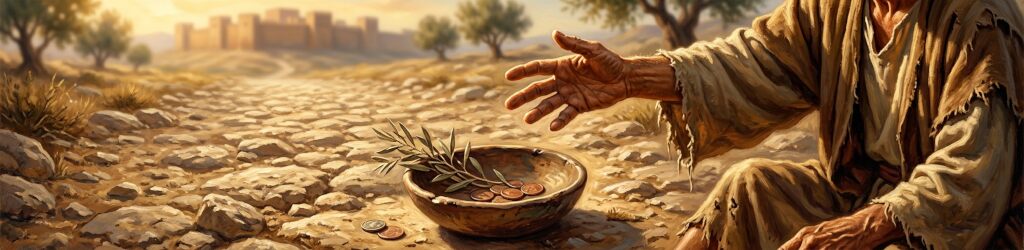
Please let me see—this simple, desperate plea from a blind beggar near Jericho captures the heart of Christian discipleship in Luke 18:35–43. In this powerful Gospel reflection, we discover how persistent faith opens our spiritual eyes, transforming us from passive observers sitting beside the road into active followers walking the Way with Jesus.
Today’s passage presents Luke’s version of the healing of the blind man, whom Mark’s Gospel identifies as Bartimaeus, the son of Timaeus. In Mark, the encounter sits at the conclusion of a long teaching section where Jesus’ disciples slowly deepen their understanding of his mission. Rich with symbolism, the episode acts as a miniature Gospel that sums up everything that came before it.
Context and Setting in Luke 18:35–43, Please Let Me See
In Luke’s Gospel, the placement of this healing is equally deliberate. It stands directly between two stories about wealthy men:
- The Rich Ruler: A highly religious man who cannot accept Jesus’ condition to share his wealth with the poor before becoming a disciple.
- Zacchaeus: A tax collector viewed as anything but religious who, after encountering Jesus, generously gives away a large portion of his wealth.
As the scene opens, Jesus is approaching Jericho, an ancient city located roughly five miles west of the Jordan River and fifteen miles northeast of Jerusalem. While the Old Testament city was largely abandoned by the first century, Herod the Great had built a thriving new city just south of the ruins. For Jesus, Jericho served as the final major stop before ascending to Jerusalem.
Interestingly, Mark places this miracle as Jesus leaves Jericho on his way to the Passion, whereas Luke situates it as Jesus approaches the city. Luke intentionally brings Jesus into and through Jericho so he can introduce Zacchaeus—another man whose spiritual eyes are opened, and a story unique to Luke’s Gospel. To explore the biblical text further, you can read the full passage of Luke 18:35–43 at the USCCB Daily Readings.
Persistent Faith on the Road to Jericho
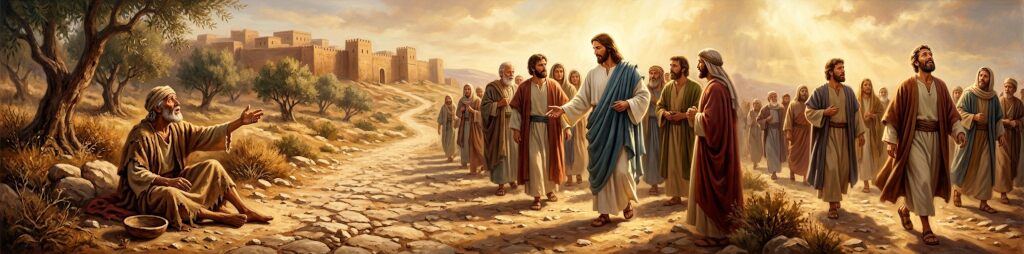
The narrative of Please Let Me See begins with a blind man sitting beside the road, begging. Throughout Luke’s Gospel, “the road” symbolizes the Way to Jerusalem—the path of discipleship that every follower must walk alongside Christ. Hearing the commotion of the passing crowd, the beggar cries out in a loud voice, “Jesus, Son of David, have pity on me!” By invoking the royal title “Son of David,” he publicly proclaims Jesus as the promised Messiah-King.
The crowd sharply rebukes him, telling him to be quiet. To them, a marginalized beggar has no right to disturb the Master. Yet he refuses to be silenced, echoing the relentless determination of the persistent widow earlier in Luke’s Gospel. At the sound of his cry, Jesus stops. Had the man yielded to the crowd’s pressure, Jesus might have passed out of his life forever—a sobering reminder of how easily social pressure or distraction can keep us from calling out to God.
Jesus then commands that the man be brought to him. Notice how grace works through community: it is almost always through other people that we come to know Christ, and sometimes we are the only bridge another person has to him. Conversely, our impatience or indifference can act as a stumbling block that prevents others from approaching Jesus. Understanding how our witness affects others is central to Catholic social teaching and evangelization.
Asking Jesus: “Please Let Me See”
When the beggar stands before him, Jesus asks a penetrating question: “What do you want me to do for you?” Christ asks each of us that very same question today. How do we answer? Have our deepest desires matured over the years? Taking quiet time to reflect on what we truly seek from God—and having the courage to ask for it—is essential to an authentic prayer life. If you want to deepen your daily conversation with Christ, explore our parish prayer and reflection resources.
Listen closely to the man’s response: “Lord, please let me see.” On the surface, it is the obvious request of someone living in physical darkness. On a deeper level, however, it is the universal prayer of humanity. Spiritual blindness prevents us from recognizing Jesus and discerning where he is leading us. We could hardly offer a better prayer than to ask for clear spiritual vision.
Jesus answers immediately: “Receive your sight; your faith has saved you.” The Greek verb used here (sozo) carries a dual meaning—it signifies both physical healing and spiritual salvation, making the person completely whole. As the Catechism of the Catholic Church teaches on faith and grace, authentic faith opens our hearts to receive God’s restorative power.
From Beside the Road to Walking the Way
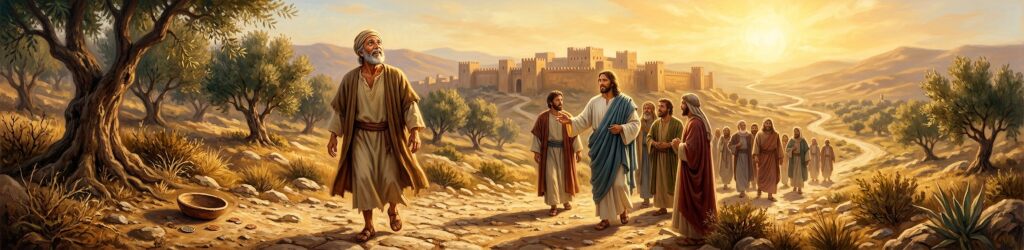
What does the man do the moment his sight is restored? He immediately follows Jesus, glorifying God. No longer blind, no longer begging, and no longer sitting beside the road, he is now on the road with Christ—who is himself the Way to Jerusalem and eternal life. True spiritual sight always leads to active discipleship and gratitude.
This contrast illuminates the surrounding stories in Luke’s Gospel. Just prior to Jericho, the rich ruler sought eternal life, yet his spiritual blindness kept him from accepting Jesus’ invitation. Immediately after Jericho, we meet Zacchaeus, whose eyes are opened and who responds with radical generosity. Ultimately, this healing also mirrors the journey of the Twelve Apostles, whose eyes would gradually open to understand why Jesus had to suffer and die on his way to glory—revealing the ultimate proof of God’s love for each of us.
When we pray, “Please let me see,” we invite Christ to heal our spiritual blindness, free us from whatever keeps us sitting on the sidelines, and give us the faith to follow him wholeheartedly along the Way.
May God Bless You and Grant You His Peace!