
The Letter to Titus offers timeless guidance for Christian leadership, community building, and faithful living. As we reach the conclusion of the liturgical year, the Scripture readings bring us to four compact yet deeply impactful books of the New Testament: the Letter to Titus: Leadership & Faith (read Monday through Wednesday), the Letter to Philemon (Thursday), the Second Letter of John (Friday), and the Third Letter of John (Saturday). The letters to Titus and Philemon appear at the end of the Pauline corpus primarily due to their brief length. Philemon is a single-chapter personal note, whereas Titus serves as a vital blueprint for church governance and pastoral care.
Historical Context and Authorship of the Pastoral Letters
Paul introduces himself in this epistle as an “apostle”—one personally commissioned by Jesus Christ to lead God’s chosen people into a deeper knowledge of the truth and true relationship with God. Along with 1 and 2 Timothy, Titus is categorized as one of the three “Pastoral Letters.” These writings consist primarily of practical leadership advice given to Paul’s trusted allies rather than general letters addressed to entire faith communities.
Scholars frequently debate the exact authorship and dating of this Letter to Titus: Leadership & Faith:
- Traditional Pauline Origin (c. 65 AD): Proponents argue Paul was released from his initial Roman imprisonment (recorded at the end of Acts) and embarked on a new missionary trip to Crete. He left Titus in charge before writing this letter to guide his ongoing work.
- Post-Pauline Origin (c. 100 AD): Other scholars suggest an anonymous author writing in the Pauline tradition composed the letters later. They point to stylistic differences and the fact that Luke’s Acts of the Apostles does not record a missionary journey to Crete outside of Paul’s voyage as a prisoner.
Regardless of academic debate, Titus was indisputably one of Paul’s most essential co-workers. Though unmentioned in Acts, his name appears 13 times across the New Testament, notably for his key role in restoring unity to the troubled church at Corinth.
The Mission of Titus in Crete
Paul greets Titus as a “true child in our common faith,” having converted under Paul’s direct ministry. Paul describes leaving Titus behind in Crete to organize the local churches—a standard practice where Paul planted spiritual seeds as a “sower” and left trusted overseers to cultivate the harvest.
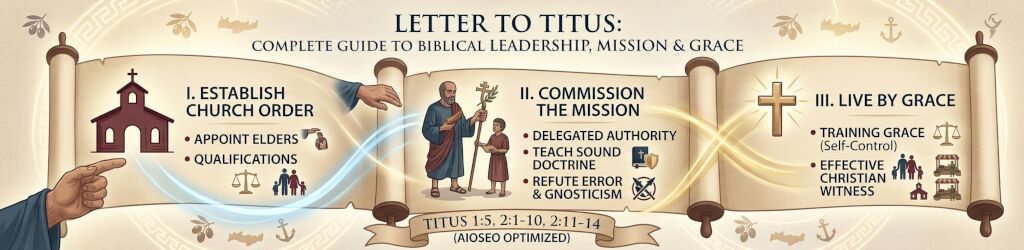
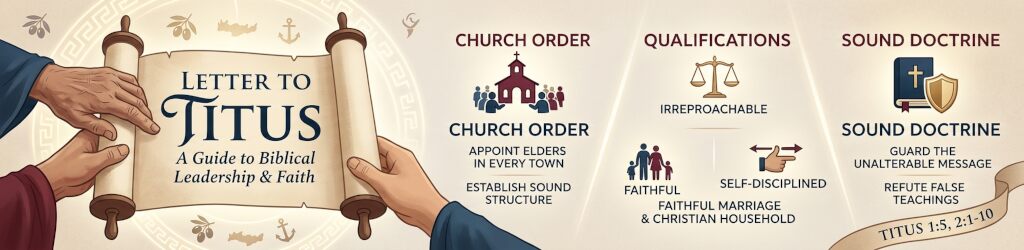
Titus’s primary task was to appoint elders (presbyters) in every town across Crete. These mature, respected individuals were ordained through the laying on of hands, signifying that their authority derived directly from God.
Core Qualifications for Leaders in the Letter to Titus
To protect the church from moral compromise and theological error, the Letter to Titus: Leadership & Faith establishes strict qualifications for anyone appointed to church leadership:
- Irreproachable Character: Must be above reproach in both public and private life.
- Faithful Marriage: A “husband of one wife,” denoting strict monogamy and marital fidelity.
- Christian Household: Children must be believers who are well-behaved and free from public scandal.
- Emotional Maturity: Not arrogant, quick-tempered, violent, or addicted to wine.
- Financial Integrity: Not greedy for dishonest gain or focused on personal profit.
- Hospitality & Discipline: Welcoming to strangers, sensible, moral, devout, and self-controlled.
- Doctrinal Soundness: Firmly grounded in the core Christian message to teach truth and refute errors.
Key Theological Themes and Cultural Context
Understanding the historical and cultural backdrop enriches our reading of these requirements:
Sound Doctrine and Refuting Error
A central theme of the Pastoral Letters is holding fast to “sound doctrine.” The Greek emphasis on health and soundness appears repeatedly to combat emerging divergent teachings, such as early forms of Gnosticism. Leaders were required to safeguard the unalterable core of the Gospel message.
Christian Witness in a Challenging Culture
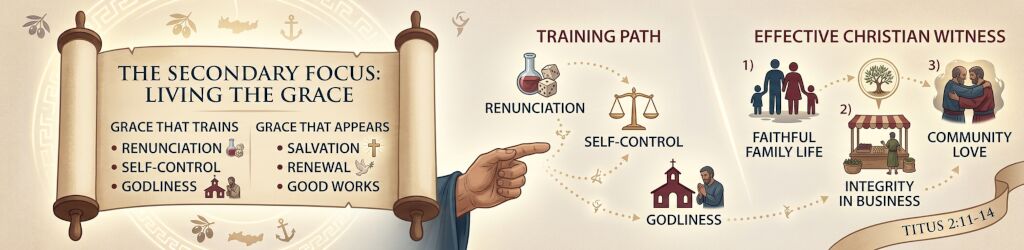
Crete had a widespread reputation in the ancient Mediterranean for moral laxity. Consequently, church leaders had to demonstrate exemplary self-control—an inner strength highlighted repeatedly across the letter’s short chapters.
Family and Community Leadership
In first-century culture, household management was viewed as the ultimate test of leadership. An elder whose family reflected peace and faith demonstrated the practical skill needed to shepherd the broader house of God.
To explore additional reflection guides on Paul’s epistles, visit our collection of daily Scripture commentaries.
Further Reading & Historical Resources
For deeper historical and biblical context on the Pauline epistles and the early Church, explore these authoritative resources:
- Examine the early historical documents and biblical texts at the Vatican Archive.
- Research manuscript history and early canonical development via the British Library Sacred Texts collection.
- Access scholarly commentaries and historical analysis through the Center for Online Judaic Studies.
Conclusion – Letter to Titus: Leadership & Faith
The Letter to Titus remains an essential testament to the power of structured, faithful leadership and moral integrity. By studying the directives given to Titus, modern believers gain timeless insight into building healthy spiritual communities grounded in sound doctrine and authentic Christian witness.
May God Bless You and Grant You His Peace!