
Why Faith in Action Matters More Than Words
Imagine a businesswoman who asks her employee, Rose, a series of absurd closing questions: “Rose, did you add two glasses of water to the cooking oil can?” “Did you put sugar in the car’s gas tank?” “Did you inject my prize fish with formalin?” Rose answers every single question with a polite, respectful, “Yes, ma’am.”
Nonsensical? Absolutely. But it highlights a crucial truth: verbal respect and quick compliance mean nothing when the underlying actions cause harm.
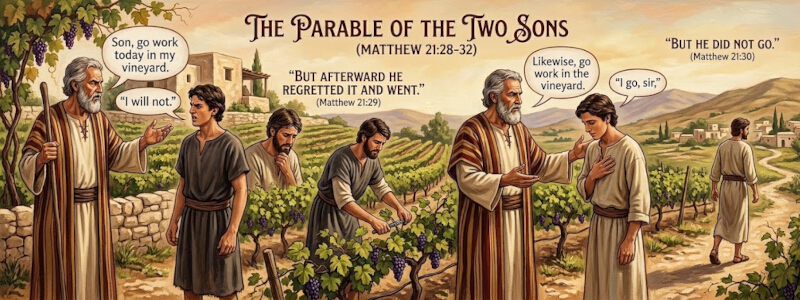
The Gospel presents a parallel dilemma in the Parable of the Two Sons: a father asks both sons to work in his vineyard. The first son refuses initially, but later regrets his defiance and goes to work. The second son instantly agrees with polite words, yet never sets foot in the field.
When asked which son did his father’s will, we naturally point to the first. Yet neither choice represents the ideal. Both sons caused their father unnecessary grief—one through initial rebellion, the other through deception. The true calling of a believer goes beyond choosing the lesser of two evils; it demands a spontaneous, joyful “Yes” backed by immediate execution.
Words Without Deeds: The Trap of Empty Piety
Consider a buyer who orders 500 ballpoint pens from an office equipment salesman. The salesman delivers an incredible pitch for half an hour, convincing the buyer of the product’s supreme quality. But when the salesman pulls out a lead pencil to write down the order, the buyer instantly cancels the deal. Why? Because the salesman’s personal practice directly contradicted his sales pitch.
We run into similar contradictions every day:
- A politician who promises sweeping community reforms, only to ignore constituents after election day.
- A Christian who acts devoutly at Sunday Mass, yet disregards basic ethics, honesty, and justice in business on Monday.
- A person who boasts about personal achievements, while an unpresuming neighbor quietly gets important work done.
As highlighted in teachings on living out active faith, people naturally judge us by our outputs, not our professions of belief. Empty promises erode trust in relationships, workplaces, and spiritual communities alike.
The Two Types of People We Meet in the World
This reflection exposes two common mindsets that shape daily human behavior:
- Better Words Than Practice: These individuals talk a great game. They recite all the right rules, declare solemn loyalty, and present an impeccable public image. Yet when real effort or sacrifice is required, their follow-through falls completely flat.
- Better Practice Than Words: These individuals rarely talk about their virtues. They might appear tough, cynical, or unreligious on the surface, yet they routinely perform anonymous acts of kindness, integrity, and generosity behind the scenes.
As the classic adage reminds us, actions speak louder than words. True integrity requires closing the gap between what we profess and how we actually live.
Bridging the Gap Between What We Say and What We Do
Neither passive agreement nor upfront defiance fulfills our potential. A complete life requires alignment—translating noble promises into concrete, everyday performance.
When you say “Yes,” commit to making your actions reflect your words continuously, without needing a second reminder or a public audience.
Are your actions matching your daily declarations? Examine where your words might be outrunning your deeds, and focus on putting genuine faith in action today.
May God Bless You and Grant You His Peace!