
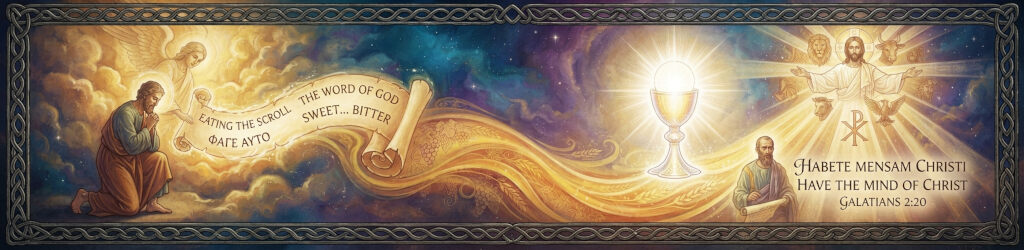
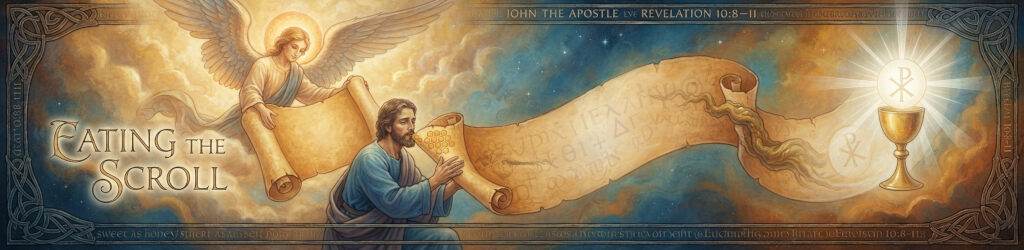
In Eating the Scroll offered by the angel in Revelation 10:8–11, John is invited to take in a revelation from God that tastes sweet as honey in the mouth yet turns bitter in the stomach. Stepping back from the sequence of the seven seals and six trumpets, this brief interlude pauses the wider dramatic arc to ask a deeply personal question: how do believers receive, internalize, and live out the Word of God?
Context Behind the Digression in Revelation
Before reaching this passage, the Book of Revelation traces the gradual opening of the seven seals on a scroll and the sounding of six of the seven trumpets. Today’s reading, Eating the Scroll: Revelation 10, interrupts that progression with a vivid vision. An angel standing on the sea and the land holds an open small scroll and instructs John: “Go, take the scroll that is open in the hand of the angel who is standing on the sea and on the land.” When John takes it, he is told to “take it and eat,” paired with the warning that it will be sweet as honey in his mouth but bitter in his stomach.
Echoes of Ezekiel and the Eucharist
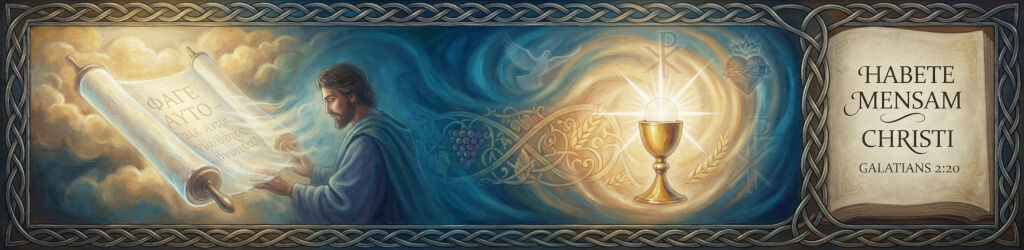
This striking image does not stand alone in Scripture. It closely mirrors the call of the prophet Ezekiel, who is commanded to eat a scroll and then bring what he has received to his people, and it recalls Jesus’s invitation to his disciples to eat his flesh and drink his blood. Across all three moments, the underlying meaning converges:
- Complete assimilation: Rather than treating sacred truth as distant information, believers are called to absorb the Word of God—and in the Gospel, the teachings of Jesus—until it becomes part of their inner life.
- Sweetness and cost: The message is sweet at first taste because it carries the promise of life and grace, yet bitter in practice because living faithfully in the world brings real trials and suffering for the Church.
- A renewed call to witness: Having received the revelation, John is commissioned to “prophesy again,” proclaiming God’s plan beyond the six trumpets into the vision that follows in Revelation 11:15.
Why Eating the Scroll: Revelation 10 Matters Today
For believers today, eating the scroll means receiving the Gospel and the full sweep of Scripture as living nourishment rather than occasional background reading. That same hunger shapes how we approach the Eucharist, which is far more than an isolated physical or devotional act—it is a shared commitment to recognize and love Christ in every person and every moment of the day.
Yet many Catholics still treat Scripture as a minor part of their daily diet, sometimes leaving gaps in basic biblical literacy that childhood catechesis alone cannot close. Growing into genuine discipleship is a lifelong work of letting Christ reshape how we see reality—cultivating the mind of Christ so that, with St. Paul in Galatians 2:20, we can say, “it is no longer I who live, but it is Christ who lives in me.”
May God Bless You and Grant You His Peace!