
The Scroll: Revelation 5 represents God’s redemptive plan for history, a mystery that no creature in heaven or on earth can unlock until the victorious Lamb steps forward. Picking up right after yesterday’s vision of God enthroned in glory, Revelation 5:1–10 reveals why Jesus alone is worthy to open what is sealed. Although chapters 6–9 unfold the contents of that scroll outside today’s liturgical reading, the symbolism of this scene turns a dense ancient text into a vivid window of hope.
How Ancient Scrolls Worked
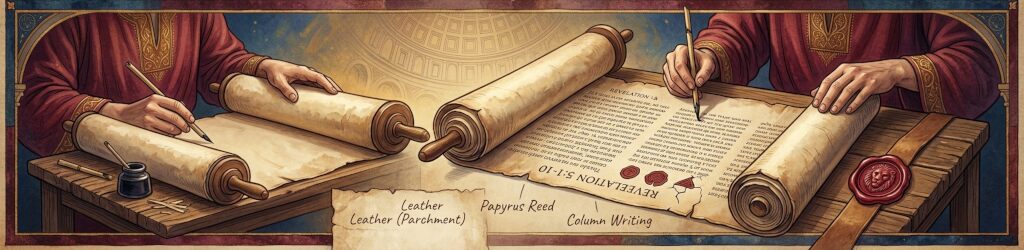
To appreciate what John sees in The Scroll: Revelation 5, it helps to picture how books looked in the first century. In Jesus’ time, people wrote on scrolls made of leather parchment or papyrus—a reed processed into sheets of rough writing material—long before the codex, or bound book as we know it today, became common in the second century AD. Scribes usually wrote in columns on one side using pen and ink, then rolled the manuscript and sealed it so only authorized eyes could read what was inside.
While some Egyptian scrolls stretched up to 100 feet long, biblical scrolls rarely exceeded 30 feet. Reading one meant unrolling with one hand while rolling up with the other, which made flipping to a specific passage slow compared to turning pages in a modern book. For readers interested in how ancient manuscripts and biblical texts were preserved and studied, resources from the Society of Biblical Literature offer helpful scholarly context.
Seven Seals and the Search for Someone Worthy
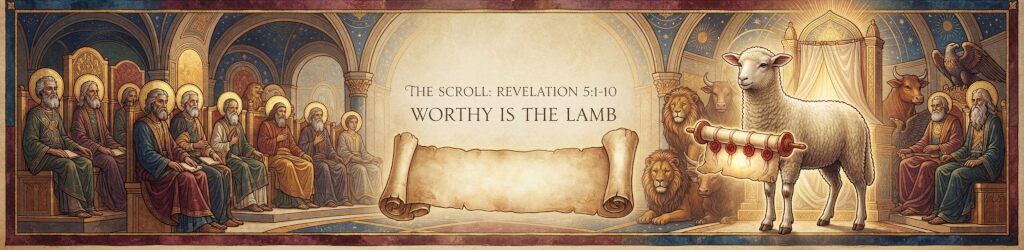
In today’s reading, John sees “the One” on the throne holding a scroll in his hands. Unlike typical scrolls, The Scroll: Revelation 5, this one is written on both sides and fastened with seven seals—echoing the seven churches addressed earlier in Revelation and signaling total secrecy from anyone unauthorized.
An angel calls out, asking who “is worthy to open the scroll and break its seals?” When no one in heaven, on earth, or under the earth can step forward, John weeps at the thought that God’s plan will remain closed. One of the twenty-four elders comforts him with a turning point:
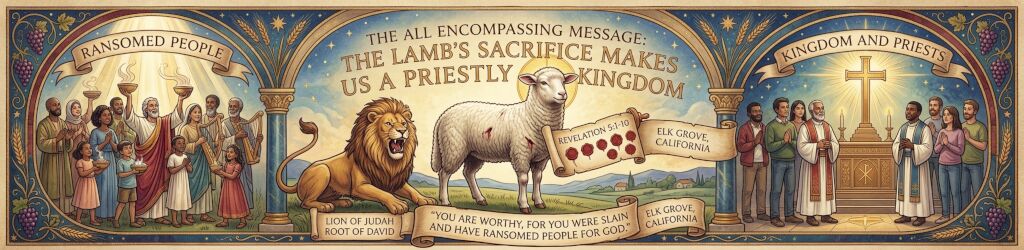
“See, the Lion of the tribe of Judah, the Root of David, has conquered, so that he can open the scroll and its seven seals.”
Two rich Old Testament titles converge in that announcement:
- Lion of the tribe of Judah: Echoing Genesis, where Judah is compared to a lion’s cub with an enduring royal promise, this title points to rightful sovereignty.
- Root of David: Drawing on Isaiah, it identifies a promised ruler from David’s royal line who brings justice and restoration.
Together, they point straight to Jesus, whose victory over sin, Satan, and death qualifies him to open what no one else can touch.
How the The Scroll: Revelation 5 Reveals the Conquering Lamb
When John looks for the roaring lion, he sees a standing Lamb that looks as though it has been slaughtered—positioned right between God’s throne, the four living creatures, and the twenty-four elders. Rather than erasing his suffering, the visible marks of sacrifice stand as trophies of resurrection triumph over death.
In John’s vision, the scroll is not opened by brute force, but by self-giving love. That is why the Lamb also carries seven horns and seven eyes:
- Seven: The biblical number of fullness and completeness, echoing the seven churches.
- Seven horns: Complete royal strength and authority.
- Seven eyes: Full spiritual insight, knowledge, and wisdom.
Interestingly, Revelation uses the Greek word arnion for “lamb” 29 times, while elsewhere in the New Testament it appears only in John 21:15 when the risen Jesus tells Peter, “Feed my lambs.” Early apocryphal writings also knew imagery of a victorious ram or lamb leading God’s flock. Readers exploring liturgical texts and scripture study tools can check the United States Conference of Catholic Bishops Bible for standard lectionary readings and notes.
Worship, Bowls of Incense, and Our Baptismal Calling
As soon as the Lamb takes the scroll from the One on the throne, the four creatures and twenty-four elders fall down and worship him just as they worship God. Each holds a harp for songs of praise alongside bowls of incense, which represent the prayers of believers rising to God—a motif rooted in Jewish prayer traditions such as Tobit 12:11–15. Popular cartoons sometimes turn heaven into people floating on clouds strumming harps, yet Revelation’s imagery points to real communion with God rather than idle cloud-gazing.
The passage culminates in a “new song” celebrating a fresh act of salvation: by his blood, the Lamb ransomed people from every race and nation and made them “a kingdom and priests serving our God.” What once described Israel as a whole now describes the entire Christian family. Through baptism and Christian life, every believer shares in Christ’s priestly, prophetic, and kingly mission—not only ordained ministers or religious. For broader background on how the Church understands the Book of Revelation and sacred scripture, the Vatican Dicastery for the Doctrine of the Faith provides official doctrinal documents and commentary.
Ultimately, the The Scroll: Revelation 5 invites gratitude rather than fear: the Lamb who gave his life in love has handed us the Gospel, a trustworthy guide to true joy and fulfillment in Christ.
May God Bless You and Grant You His Peace!