
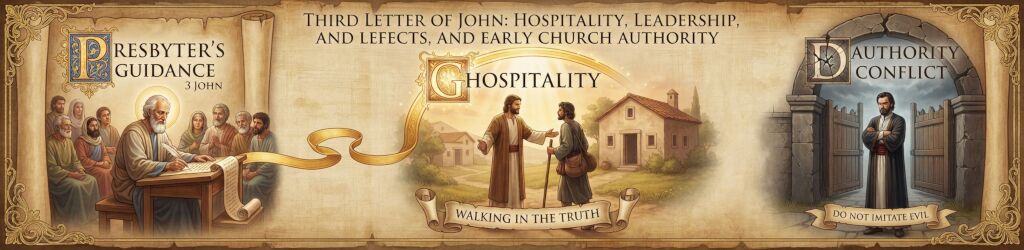
John’s Third Letter: Hospitality & Authority preserves a brief glimpse into the challenges of missionary activity and local autonomy in the early church. Unlike the other Johannine epistles written to broader communities, this concise work was addressed directly to a specific individual named Gaius. While less doctrinal in content and purpose than the First and Second Letters, it reveals crucial dynamics about how early Christian communities operated. The author’s primary goal was to secure hospitality and material support for traveling missionaries. Writing as “the Presbyter” (or Elder), he reaches out to a trusted church member who had generously welcomed missionaries in the past, commending Gaius for his Christian hospitality and encouraging his continued assistance—particularly for a bearer named Demetrius—while preparing to confront the divisive policies of a local leader named Diotrephes.
Early Church Authority and the Conflict with Diotrephes
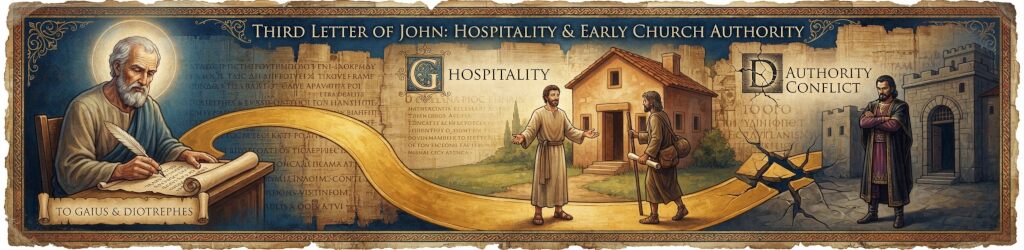
The tensions facing the Presbyter in the John’s Third Letter: Hospitality & Authority provide valuable historical evidence regarding the flexible and personal nature of early church authority. Rather than relying on an established institutional hierarchy, the Presbyter appeals to Gaius—whom he may have personally converted or instructed—on the strength of their mutual friendship and shared faith.
In sharp contrast to Gaius’s faithful cooperation, Diotrephes refuses to welcome either the Presbyter’s letters or his emissaries. While the text portrays Diotrephes as ambitious and hostile toward the Presbyter’s leadership, biblical scholars at institutions like the United States Conference of Catholic Bishops note that his behavior may reflect the cautious, protective nature of early local congregations. During an era marked by wandering preachers and competing interpretations of the Gospel, local leaders often mistrusted unfamiliar missionaries as potential false teachers.
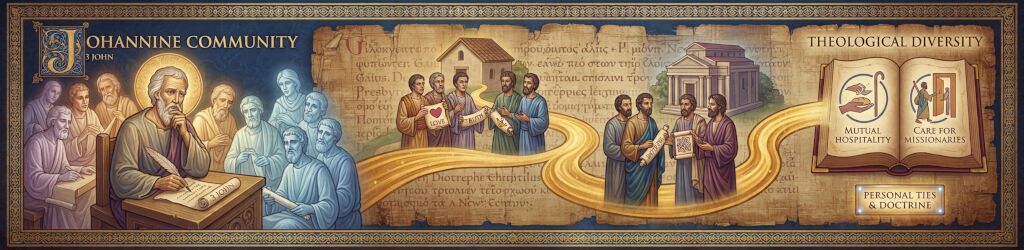
Most notably, Diotrephes appears entirely comfortable ignoring the Presbyter’s written requests, prompting the Presbyter to acknowledge that only an in-person confrontation will resolve the impasse. Furthermore, this administrative standoff likely masked deeper theological divisions within the Johannine community, where Gaius and the Presbyter’s “friends” embraced one doctrinal tradition while Diotrephes rejected it out of suspicion of theological error.
Three Scholarly Views on Diotrephes’ Motives
Because the John’s Third Letter: Hospitality & Authority offers only one side of this ancient dispute, historians and theologians have proposed three primary interpretations of Diotrephes’ actions:
- An Ambitious Local Upstart: Some scholars view Diotrephes as a power-hungry leader attempting to consolidate his own local authority by blocking the advance of apostolic missionaries.
- A Defender of Orthodoxy: Others suggest Diotrephes was a cautious church official who genuinely suspected the Presbyter and his Johannine school of promoting unorthodox teachings.
- A Protective Pastor: A third perspective sees Diotrephes as a pragmatic local leader anxious to insulate his congregation from the internal doctrinal debates tearing apart the broader Johannine community.
Unity and Division in John’s Third Letter: Hospitality & Authority
Ultimately, this brief correspondence and the historical crisis it mirrors demonstrate how much remains unknown about the intricate development of early Christianity. As we also explore in our previous reflection on John’s Letters (Part One), the first-century church was not a monolith, but a network of house churches navigating complex questions of faith, leadership, and communal boundaries. As modern biblical reference resources like Britannica highlight, differing theological schools existed alongside one another, and personal relationships—just as much as formal doctrine and early church authority—shaped how believers navigated both division and unity within the John’s Third Letter: Hospitality & Authority.
May God Bless You and Grant You His Peace!