
Early Christian tradition identified the John’s Letters as works written by John the apostle, offering profound insights into early church doctrine, apostolic witness, and Christian love. Because of their striking resemblance to the fourth gospel in style, vocabulary, and theological ideas, scholars generally agree that these writings are the product of the same school of Johannine Christianity and his Apostolic Authorship.
The Origins John’s Letters: Apostolic Authorship
The terminology and the presence or absence of certain theological ideas in 1 John suggest that it was written after the Gospel of John. It may have been composed as a short treatise expanding on ideas developed more fully in the fourth gospel, or as part of an early debate on the proper interpretation of that gospel.
Whatever its exact relation to the gospel, 1 John is widely dated toward the end of the first century. Unlike 2 and 3 John, it lacks the traditional salutation and epistolary conclusion of an ancient letter. These structural features, combined with its prologue and heavy emphasis on doctrinal teaching, make it more akin to a theological treatise than to most other New Testament letters. You can read the full text of the First Letter of John on the USCCB website to see its unique prologue firsthand.
Combating Heresy and Defining Apostolic Truth
The primary purpose of the first letter is to combat false ideas about Jesus and to deepen the spiritual and social awareness of the Christian community. Some former members of the community refused to acknowledge Jesus as the Christ and denied that he was a true man. While the specific heresy cannot be identified with absolute precision, it closely aligns with early forms of Docetism or Gnosticism:
- Docetism: Denied the physical humanity of Christ to ensure that his divinity remained untainted by the material world.
- Gnosticism: Viewed the earthly appearance of Christ as a mere stepping-stone to a secret, higher knowledge of God.
The Letters of John firmly reject these theological errors by appealing to the reality and continuity of the apostolic witness to Jesus. The author affirms that authentic Christian love, ethics, and faith take place only within the historical revelation and sacrifice of Jesus Christ.
The fullness of Christian life as fellowship with the Father must be based on true belief and result in charitable living. Knowledge of God and love for one another are inseparable; error in one area inevitably affects the other. Although the author recognizes that Christian doctrine presents intangible mysteries of faith, he insists that concrete Christian living brings to light the deeper realities of the gospel.
Literary Style and Theological Contrasts
The structure and language of 1 John are straightforward yet deliberately repetitious. To illustrate the threats and responsibilities of Christian life, the author sets forth striking contrasts:
- Light and darkness
- Christians and the world
- Truth and error
The result is not a dry theological argument, but an expression of intense religious conviction conveyed through simple, memorable truths in John’s Letters. The letter remains invaluable for its clear declaration of the simultaneous humanity and divinity of Christ as core apostolic teaching, and for its development of the intrinsic connection between Christian moral conduct and sound doctrine—themes frequently explored in our broader Catholic scripture study resources.
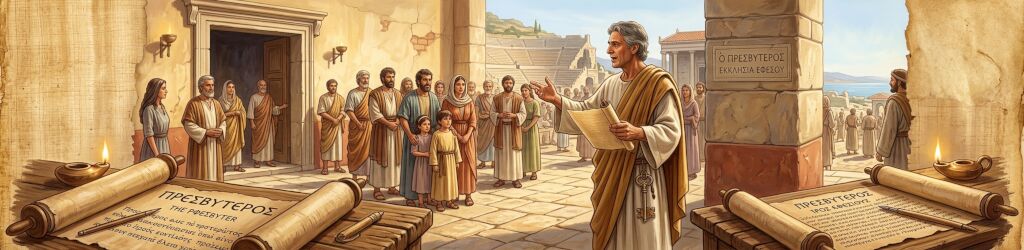
The Presbyter and the Second of John’s Letters
Written in response to similar community problems, the Second and Third Letters of John are nearly identical in length—likely determined by the practical constraint of fitting onto a single sheet of papyrus. In each letter, the writer refers to himself simply as “the Presbyter.” Their common authorship is further evidenced by internal similarities in style and wording, particularly in their introductions and conclusions.
The literary threads that link 2 John and 3 John also bind them to 1 John and the Gospel of John. Shared concerns with “truth,” Christology, mutual love, the new commandment, the antichrist, and the integrity of witness to the earthly Jesus clearly mark these works as products of the Johannine school.
While the exact identity of the Presbyter remains unknown, the title implies more than advanced age; it points to a recognized position of authority in the early church. The absence of a proper name indicates that he was well known to the communities he addressed. Although traditionally attributed to John the apostle, these letters were likely penned by a close disciple or scribe of the apostle in Ephesus around the end of the first century, as noted in the Pontifical Biblical Commission’s writings on Sacred Scripture.
Pastoral Advice in 2 John
The Second Letter is addressed to “the chosen Lady” and “to her children”—a literary personification of a specific local Christian community. Unlike 1 John, this brief epistle (the shortest book in the Bible) is not a formal treatise, but an urgent reply to active threats within the church.
The Presbyter uses the familiar Johannine themes of love and truth to deliver practical pastoral advice. He urges community members to demonstrate their faith by adhering to the great commandment of mutual love and holding fast to the historical truth of Jesus. Because a spiritualizing Christology threatened to undermine belief in the incarnation and death of Jesus, the Presbyter strictly forbids extending hospitality to traveling teachers who promote these errors, protecting the flock from infiltration. Ultimately, John’s Letters preserve the vital balance of doctrinal purity and active charity for a threatened early church, setting the stage for the personal conflicts we will explore in 3 John tomorrow.
May God Bless You and Grant You His Peace!