
Learn how making moral choices by applying Catholic principles guides your voting decisions, protects life, and serves the common good.
Yesterday, I began a three-day series exploring how Catholics—and all readers of these Daily Reflections—can approach civic duty with moral clarity. Deciding how to vote on candidates, ballot propositions, and public policies requires deep reflection. Today, we continue by examining key elements from the U.S. Conference of Catholic Bishops’ (USCCB) document, Forming Consciences for Faithful Citizenship.
Understanding how to navigate making moral choices by applying Catholic principles helps believers fulfill their calling to participate in public life while advancing justice, peace, and the common good.
Our Call as Catholic Citizens in Public Life
Every individual living in our society is invited to contribute to the common good. As Catholics, we are blessed with a rich tradition of moral teaching that helps us evaluate policy platforms, candidate promises, and legislative proposals through the lens of the Gospel.
Why the Church Teaches on Public Policy
Participating in shaping society’s moral character is not an extra task—it is a core requirement of our Christian faith. Guided by faith and reason, Catholics are called to bring truth to political dialogue and carry out Christ’s commandment to “love one another” (John 13:34).
- Religious Freedom: The U.S. Constitution protects the rights of believers and institutions to live out their faith publicly without government interference or favor.
- Pluralism in Action: Bringing faith-informed convictions into the public square enriches democracy rather than threatening it.
- A Consistent Ethical Framework: The Catholic Church offers a principled stance on human life and dignity that transcends narrow partisan agendas.
Who Should Participate in Political Life?
In Catholic tradition, responsible citizenship is a virtue, and political participation is a distinct moral obligation.
- Prioritize Conviction Over Party: Catholic voters must be guided more by moral principles than by blind loyalty to any political party or special interest group.
- Overcome Political Disenfranchisement: Many Catholics feel politically homeless today because few candidates fully mirror the Church’s comprehensive vision for life and human dignity. This reality should energize, not discourage, our civic action.
- Engage at Every Level: Lay Catholics should run for office, engage within political parties, advocate for critical issues, and communicate directly with elected officials.
- Raise Every Voice: Even those unable to vote—such as youth or non-citizens—can speak out on policies affecting their families and communities.
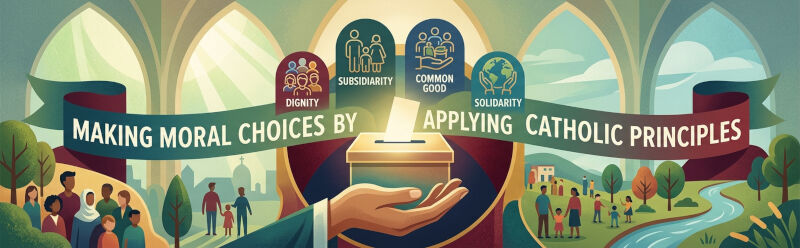
The Four Pillars: Making Moral Choices by Applying Catholic Principles
In his guidance on social reality, Pope Francis emphasizes that progress in peace, justice, and fraternity relies on core pillars of Church doctrine. Together, these principles create a coherent moral framework for advancing a “consistent ethic of life”—one that respects every human being from conception to natural death.
1. Dignity of the Human Person
Human life is sacred because every person is created in the image and likeness of God (Genesis 1:27). As outlined in the Compendium of the Social Doctrine of the Church, every human being possesses an unrepeatable, inviolable uniqueness.
- Political, economic, and social systems must serve human beings, not vice versa.
- We must view every neighbor without exception as “another self,” prioritizing their life and access to essential needs (Gaudium et Spes, no. 27).
2. Subsidiarity and the Role of Families
Subsidiarity teaches that higher-level organizations should not overwhelm or usurp the roles of local institutions and communities.
- The Family Unit: The family—built on marriage between a man and a woman—is the fundamental sanctuary of society. Economic and social policies must prioritize supporting families.
- Balanced Governance: Larger institutions have a duty to step in when local efforts cannot adequately meet human needs, defend rights, or guarantee the common good.
3. The Common Good and Human Rights
The common good represents the sum total of social conditions allowing individuals and groups to reach fulfillment.
- Essential Rights: Rights to life, religious freedom, food, shelter, education, healthcare, and employment are fundamental to human decency.
- Economic Justice: The economy must serve people. Workers deserve fair, living wages, safe conditions, and the right to organize. Likewise, immigrants deserve paths to citizenship and equal protection.
- Care for Creation: As highlighted in Laudato Si’, caring for our “common home” involves overcoming pollution, biodiversity loss, and resource scarcity as part of our moral duty.
4. Solidarity and Option for the Poor
Solidarity is a firm commitment to the well-being of all, rooted in the understanding that we are one human family despite racial, ethnic, or national differences.
- Drives us to combat poverty, end human trafficking, eliminate racism, and seek peaceful solutions over conflict.
- Expresses a preferential option for the poor, weak, and vulnerable—including the unborn, elderly, and marginalized.
Conclusion
In light of these principles, the Catholic bishops call for a renewed politics centered on moral integrity, human dignity, and the common good. By focused action and making moral choices by applying Catholic principles, voters can evaluate candidate platforms with clarity, look beyond simple partisan loyalty, and help build a more just society.
May God Bless You and Grant You His Peace!