I have often said, in these Daily Reflections, that it sometimes is useful to read the entire chapter from which the day’s readings are taken. That is particularly true with today’s first reading (Isaiah 22:19-23). Shebna has a rather lofty image of himself, in part because he holds a lofty position in the palace. He has begun to immortalize himself by constructing a tomb for himself in a lofty place on the mountain. Yet God tells him that he is no better than the lowliest man in the kingdom. God tells him that he will be wadded up like a ball of trash and that he will be thrown out of the country. There he will die in disgrace.
God not only takes away Shebna’s symbols of authority, but calls somebody else, from a different family, to bless God’s people. Eliakim will be a “father” to the people of Jerusalem, and all the people will be his family under God. Instead of using power with haughty presumption based on family origin, Eliakim will be steadfast and use his authority for peace.
The Gospel passage today (Matthew 16:13-20) is another example where God changes who is in charge, from a simple fisherman to a sturdy rock. As only God can do, he does this using only one man. The reading begins with Jesus asking his disciples who the people think he is. Jesus calls himself “Son of Man” here, thus identifying himself with the Messianic figure in Daniel 7:13-14: “I saw one like the Son of Man coming with the clouds of heaven…To him was given dominion and glory and kingship, that all peoples, nations, and languages should serve him. His dominion is an everlasting dominion that shall not pass away, and his kingship is one that shall never be destroyed.”
In reply, the disciples give various answers: the prophet John the Baptist, recently executed by Herod, returned to life; others, that he was the prophet Elijah, who went to heaven in a fiery chariot and was expected to return as a sign of the imminent coming of the Messiah; or the prophet Jeremiah, who through his own experience of rejection and suffering, announced the rejection and suffering of the Messiah. What is clear is that while Jesus is seen by the people as a prophet, a spokesperson for God. He is seen as no more than that.
Then Jesus asks his disciples who they think he is. Peter, assuming his recognized leadership role in the group, replies: “You are the Messiah, the Son of the living God.”
It is indeed a dramatic moment in their relationship with Jesus. For they have now acknowledged that their rabbi, their teacher, their guide, is no less than the long-awaited Messiah, the anointed king of Israel. It is a major recognition for them but, as the rest of the Gospel will show, they still have a long way to go to fully understanding just what ‘messiahship’ will mean for Jesus – and for them. We are in the same position. Perhaps we recognize in Jesus the Son of God, but we have a long way to go to completely understand and accept the full implications of being his followers.
Now follows a passage that will be the foundation for the authority given to the disciples, and to Peter, in the post-Resurrection community. In response to Peter’s declaration of faith, Jesus now says: “And I tell you, you are Peter [he changes his name from Simon to Peter], and on this rock I will build my church … .” Peter is then given a special stewardship and responsibility for the community: “I will give you the keys of the kingdom of heaven …, and whatever you bind on earth will be bound in heaven; and whatever you loose on earth will be loosed in heaven.”
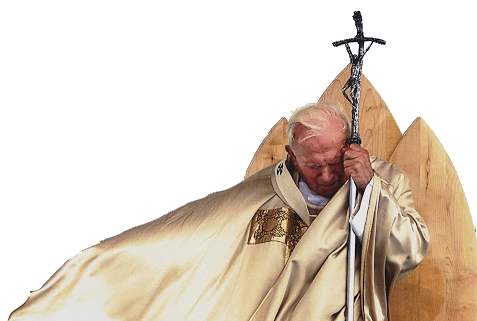
Today these verses are quoted to help us see in the pope the successor of Peter. He shares the same charism, or gift of leadership, leadership of service. Traditionally the popes have called themselves Servus servorum Dei, the ‘servant of the servants of God’. The pope is not a dictator with absolute powers as he is sometimes depicted. He is limited by the faith of the whole Church. He is not the originator of that faith; he does not decide what we should believe. Rather, he communicates to the Church at large what it already believes. He is the focal point of unity of that one faith, the unity in the Spirit. The pope is the servant of that one community united in one faith.
In a Church where there are now many conflicting theologies and spiritualities, there has never been a greater need for a focal point, not of uniformity, but of Christian unity. “There is one body and one Spirit, just as you were called to the one hope of your calling, one Lord, one faith, one baptism, one God and Father of all, who is above all and through all and in all.” (Ephesians 4:4-6)
This is something that many of our Anglican and Lutheran brothers and sisters are becoming aware. It is something whose importance is well realized by our Catholic brothers and sisters in parts of the world where they are as scattered and cut off from each other as they are.
The pope is our point of reference, whom we must always consider, as we search for new understandings of what it means to be a disciple of Christ in a constantly changing world. He is the shepherd that keeps us in fellowship with Christians everywhere, but who must not stifle the creativity of the Spirit in living out the Gospel. We are simultaneously one Church (with a capital “C”) and many churches (with a lower case “c”).
Critics correctly point out that the history of the Church is blemished by those who were corrupted and used their keys for self-establishing indulgence. As with Shebna, God brought them down to size. Power can be used as a prop, a crutch to assist the insecure of spirit. Those people failed to realize that true power is received, not grabbed and wielded like a club. Remember that we receive the Eucharistic with hands stretched out to accept this blessed gift. These are the same hands that are making the new and present history of Christ’s church. This power does not corrupt, but in the hands of the faithful, it gives life to the world in His Name.
May God Bless You and Grant You His Peace!