
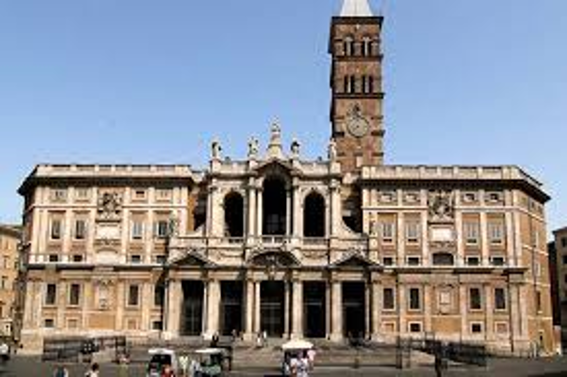
The Basilica of St. Mary Major is one of the oldest and most important churches in the world and is dedicated to the Blessed Virgin Mary. In fact, it was built at her request!
According to tradition, a Roman Patrician, Giovanni, and his wife were childless and prayed to the Blessed Mother that she would designate an heir for them to bequeath their wealth. They had a vision in which the Blessed Mother told them that she wished to have a church built in her honor on the Esquiline Hill in Rome. They were told by Mary to look for the layout of the church which would be outlined in snow–this in the sweltering month of August!
When Giovanni approached his friend, Pope Liberius, with this news he was amazed to find out that on that same night, August 4th, 352, the Virgin Mary had also appeared to Pope Liberius. She said a miraculous snowfall would occur that would outline where the church was to be built in her honor. The next day, August 5th, snow indeed did fall on the Esquiline Hill in Rome in the middle of a heat wave. The people staked off the outline of the future Basilica before the snow could melt. Pope Liberius immediately ordered the basilica to be built. The event provides us with one of Our Lady’s oldest titles, Our Lady of the Snows.
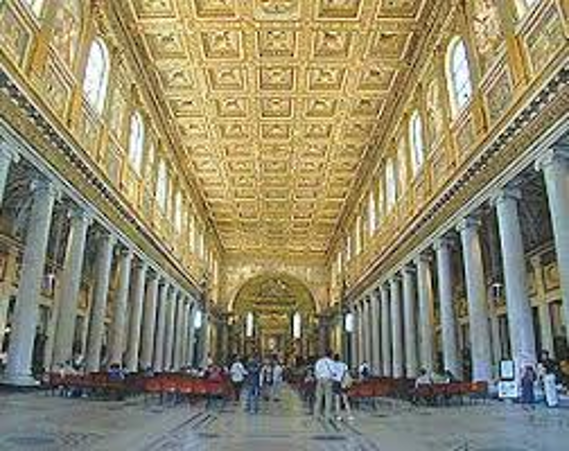
The Basilica of St. Mary Major contains some the finest artwork and architectural wonders in the world. The ceiling is a masterpiece of the Renaissance and is the work of Giuliano da Sangallo. It is gilded with the first gold brought back from the New World by Christopher Columbus. It was presented to Pope Alexander VI by King Ferdinand and Queen Isabella of Spain.
There are two especially noteworthy Christian treasures in this basilica: The most notable is a relic of the manger from Bethlehem in which the baby Jesus was lain. This relic is venerated under the High Altar of the Basilica. The second is the painting of the Blessed Mother known as the Salus Populi Romani, (The Salvation of the Roman People) for the exceptional devotion that the people of Rome have for this image of the Virgin. Tradition attributes the painting to St. Luke. This image and the manger relic had been brought back from the Holy Land by St. Helena, mother of the Emperor Constantine. Opposite the High Altar is a marble statue of Pope Pius IX, who proclaimed the dogma of the Immaculate Conception in 1854.
During the pontificate of Pope St. Gregory the Great (590-604), the plague attacked the people of Rome and the Pope carried the Salus Populi Romani in procession to pray to their Protectoress for an end to the plague. When the plague ended, the pontiff solemnly placed crowns of gold and gems on the heads of Mary and the child Jesus on the miraculous image.
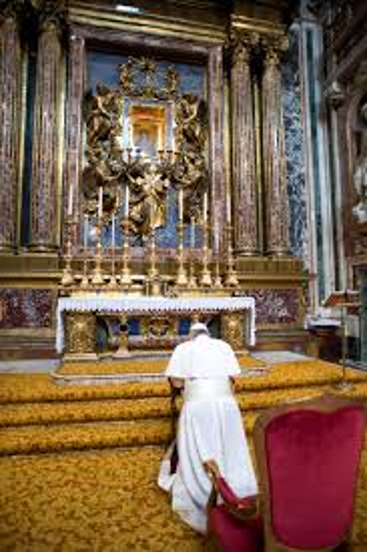
Pope Francis, the day after his election as Pope, visited the Basilica to pay tribute to the Blessed Mother and to pray at the High Altar. He often visited there, especially before and after any foreign trips.
Also of interest is the altar in the Sistine Chapel (not the same Sistine Chapel as the one in Saint Peter’s Basilica, of course) at which Saint Ignatius of Loyola, founder of the Jesuits, celebrated his first Mass on Christmas Eve, 1538.
Another point of interest is the head of Saint Pancras. As a 14-year-old orphan, he converted to Christianity. He was brought to Rome by his uncle, Saint Dionysius. He was martyred there, along with Saint Nereus, Saint Achilleus, and Saint Domitilla for publicly proclaiming his faith around 304 AD. Some of his relics were taken to England, where you will find many churches that are dedicated to him.
Two Popes are entombed here: Sixtus V and Saint Pius V. In addition, the relics of Saint Jerome, a Doctor of the Church, rest here, although it is uncertain whether they are under the Papal Altar within the main body of the church or within the confessio of the chapel in the right transept.
The Feast of the Dedication of the Basilica of Saint Mary Major is celebrated each year on the 5th of August. A beautiful custom is kept that memorializes the miraculous snowfall. At the conclusion of the Solemn Mass of that day, a shower of white rose petals falls from the dome of the Chapel of Our Lady where the image Salus Populi Romani is kept.
Here is a video of that event: https://youtu.be/XtQunUx2Wvg.
May God Bless You and Grant You His Peace!