
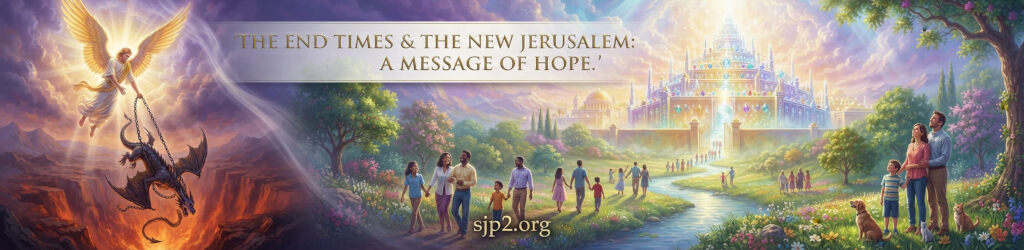
Scripture passages about the end times often spark intense curiosity and fear, yet the Book of Revelation, End Times: Revelation 20 and 21, offers a message of profound hope rather than a literal timeline. When we examine Revelation 20:1–4 and 20:11–21:2, we encounter a powerful vision of final judgment and the New Jerusalem. Because this passage uses rich, symbolic apocalyptic imagery, we must avoid getting lost in literal interpretations and instead focus on its central spiritual truth: Christ’s ultimate victory over evil and the promise of eternal life for the faithful.
To understand this vision clearly, we can break the scripture reading down into five distinct movements.
1. The Binding of Satan in the Abyss
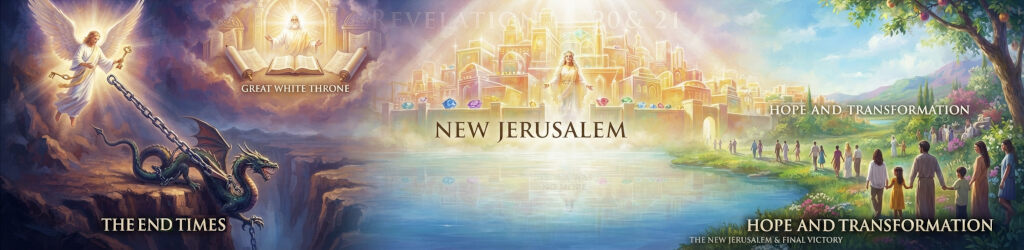
In the first section, of the End Times: Revelation 20 and 21, John sees an angel descending from heaven—a symbol for God’s omnipresent authority rather than a physical location. The angel holds a massive chain and the key to the Abyss, which ancient cosmology viewed as a subterranean realm of demons, echoing the “primeval deep” in the Genesis creation account.
The angel overpowers the dragon—identified as the “ancient serpent” from Eden, Satan himself—and binds him in the Abyss for a thousand years. While dragons symbolize power and wisdom in many Asian traditions, Old Testament imagery consistently uses sea monsters and dragons to represent the enemies of God.
Crucially, the “thousand years” (a millennium) is not a literal calendar measurement; in biblical numerology, it signifies an indefinitely long period of time. Because Satan will eventually be released for a brief period before his final defeat, this symbol serves as a sober reminder against spiritual complacency. Even in times of relative peace, believers must remain vigilant against temptation.
2. The Reign of the Elect and the Martyrs
The vision then shifts to thrones occupied by those granted the authority to judge. These figures likely represent either the 24 elders mentioned earlier in Revelation or the Twelve Apostles, recalling Jesus’ promise that his followers would sit on twelve thrones judging the tribes of Israel (Matthew 19:28).
Alongside them stand the faithful elect, defined by two key characteristics:
- The Martyrs: Those who were beheaded for proclaiming the Gospel. In the Roman Empire, beheading was a swift execution reserved for higher-status citizens, whereas lower classes faced brutal deaths like crucifixion.
- The Uncompromised Faithful: Those who refused to worship the beast (the Roman emperor) or receive its mark on their foreheads or hands. While apostate Christians may have accepted physical branding or certificates to escape state persecution, faithful believers rejected this mark of shame, belonging solely to Christ.
Because of their fidelity, these martyrs “came to life and reigned with Christ a thousand years.” Throughout Christian history, theologians have interpreted this symbolic millennium in several ways:
- Historical Recovery: Some view the “first resurrection” as the Church’s triumph and growth following the collapse of Roman persecution.
- The Augustinian View: St. Augustine of Hippo taught that the “first resurrection” occurs at Christian baptism, and the thousand-year reign represents the entire present age of the Church between Christ’s Resurrection and the Last Judgment—a teaching preserved in the Catechism of the Catholic Church.
- Censured Millenarianism: Early literalist beliefs that Christ would return to establish a physical thousand-year earthly kingdom were eventually rejected by the broader Church as a misreading of apocalyptic genre.
3. The Great White Throne and the Book of Life
The End Times: Revelation 20 and 21In the third section, the scene transitions to the universal judgment of the dead. God is enthroned in dazzling majesty on a great white throne, and the physical universe—earth and sky—vanishes before his presence.
Humanity from every walk of life stands before the throne as books containing the records of their lives are opened. Alongside these deeds sits the “Book of Life.” First mentioned in the Book of Exodus as a registry of God’s covenant people, having one’s name inscribed in this book signifies true citizenship in God’s Kingdom, awarded to those who have genuinely responded to the Gospel (Romans 2:2–9).
4. Final Judgment and the Defeat of Death
Next, the traditional abodes of the dead—the sea and “Death and Hades” (the Greek equivalent of the Hebrew Sheol, or underworld)—surrender all who reside within them. Everyone is judged according to what they have done.
However, Scripture clarifies that being judged by our works does not mean we “earn” salvation through a celestial accounting system of credits and debits. Good works are never self-generated; rather, they are the fruit of God’s grace working within an open, transformed heart. As the Roman Missal’s Weekday Preface IV beautifully prays, “You have no need of our praise, yet our desire to thank you is itself your gift.” Furthermore, God does not tally a lifetime balance sheet; he looks at the state of our hearts when he calls us, meaning a life spent wandering from God can be redeemed in its final moments, much like the Good Thief on the cross (Luke 23:39–43).
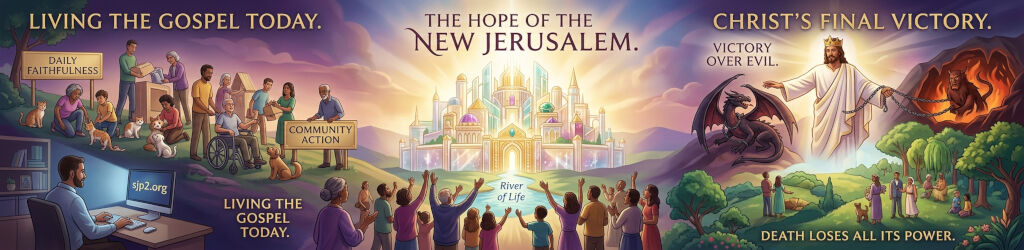
Following this judgment, Death and Hades are cast into the “lake of fire.” This imagery draws directly from Gehenna (the Valley of Hinnom south of Jerusalem), a site notorious for ancient pagan child sacrifices to Molech that King Josiah later desecrated into a smoldering refuse dump. In apocalyptic literature, this fire symbolizes total, irreversible destruction: death itself loses all power forever, and those who persistently rejected God’s grace remain separated from the Kingdom by their own free choice.
5. End Times: Revelation 20 and 21 Meaning for the New Jerusalem and Our Daily Lives
In the final section (Revelation 21:1–2), John beholds “a new heaven and a new earth.” This vision describes a renewed cosmos completely liberated from decay, suffering, and corruption, where humanity lives face-to-face with God (Romans 8:19–25). Notably, “the sea was no more.” Because ancient Israel viewed the turbulent sea as the chaotic dwelling place of evil, its disappearance signifies the permanent eradication of Satan’s domain as the New Israel advances in triumph.
In place of chaos stands the Holy City, the New Jerusalem, descending like a bride adorned for her husband. Drawing on the nuptial imagery of the prophets Isaiah and Hosea, this reveals the profound, intimate union between Christ and his Church.
Ultimately, biblical teaching on the End Times: Revelation 20 and 21 is not meant to fuel anxious speculation or decode secret timelines. Instead, it calls us to live faithfully in the present moment—seeking, recognizing, and loving Jesus in our daily encounters. When we anchor our lives today in his grace, we can entrust the future completely to his care, holding fast to his enduring promise: “Remember, I am with you always, to the end of the age” (Matthew 28:20). For further reflection on living out these daily Gospel readings, explore our latest Sunday Scripture reflections.
May God Bless You and Grant You His Peace!