
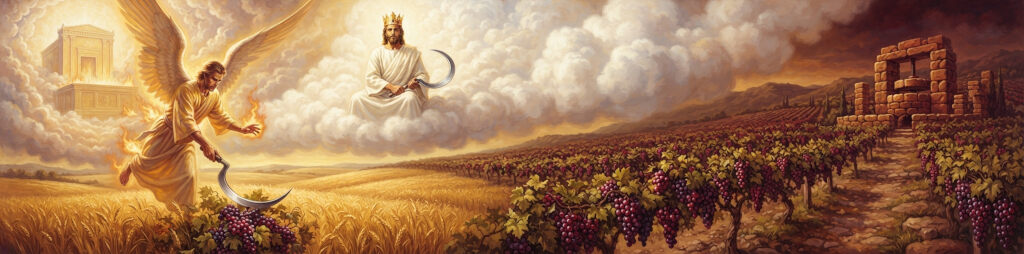
Exploring The Final Harvest – Revelation 14:14-19 reveals a striking vision of the final harvest, contrasting the gathering of the righteous with God’s judgment on the wicked. While the complete destruction of the wicked is developed further later in the book (Revelation 19:11–21)—a passage omitted from our liturgical readings—today’s scripture draws directly on imagery from the prophet Joel (Joel 3:13):
“Put in the sickle, for the harvest is ripe. Go in, tread, for the winepress is full. The vats overflow, for their wickedness is great.”
In this prophetic picture, the grain harvest symbolizes the faithful, while the grape vintage represents those facing judgment.
The Son of Man and the Grain Harvest in Revelation 14:14-19
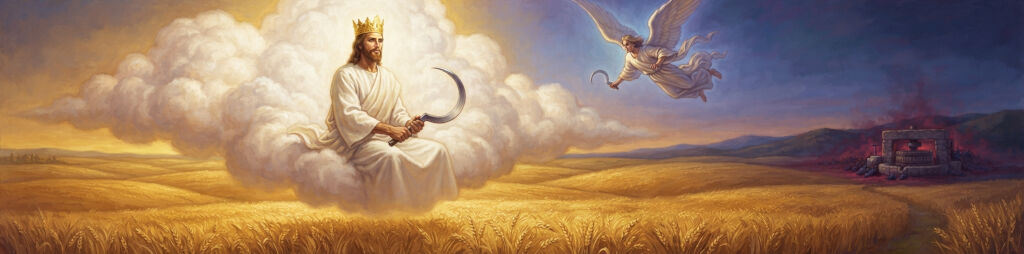
As John’s vision unfolds in The Final Harvest – Revelation 14, he sees “a white cloud, and seated on the cloud was one like the Son of Man, with a golden crown on his head and a sharp sickle in his hand.” Every detail in this scene carries deep biblical meaning:
- The Son of Man and the Cloud: “Son of Man” refers directly to Christ, while the cloud signifies the divine presence and God’s heavenly throne.
- The Golden Crown: This crown is a wreath of victory, celebrating Christ’s triumph over sin and death.
- The Sharp Sickle: Resembling the curved iron or flint harvesting tool used by ancient Israelites, the sickle shows Christ acting as Judge to gather the elect—those who have remained faithful to his Word.
When a second angel calls out, “Use your sickle and reap, for the hour to reap has come, because the harvest of the earth is fully ripe,” it signals the arrival of the final judgment and the gathering of the righteous into God’s kingdom. For more parish scripture reflections and liturgical resources, visit Saint John Paul II.
The Angel of Fire and the Winepress of Judgment
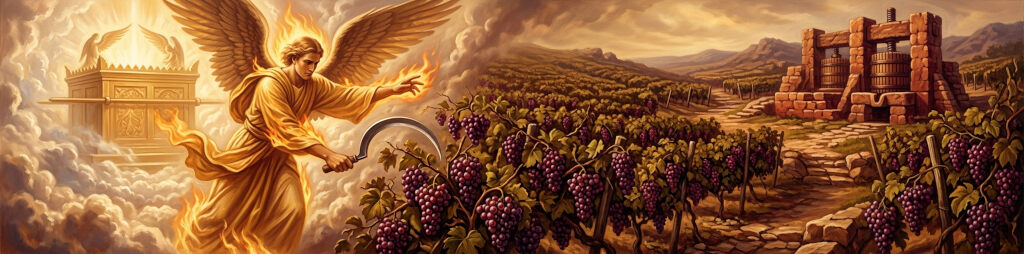
In the second half of the passage, another angel emerges from the “temple in heaven”—God’s dwelling place—carrying a sharp sickle and holding “authority over fire.” In Jewish tradition, specific angels were associated with elements of creation such as wind, water, and the abyss; here, fire symbolizes divine judgment, which both destroys evil and purifies the good. Because this angel comes “out from the altar” where the prayers of persecuted martyrs rise before God, the vision assures believers that justice will answer their suffering.
This angel calls for the clusters of the earth’s vine to be gathered with a smaller pruning knife and cast into “the great winepress of the wrath of God.” In the ancient world, a winepress consisted of an upper rock-hewn trough—roughly eight feet square—connected by a channel to a smaller lower vat where juice flowed as grapes were trampled barefoot or pressed. Old Testament prophets frequently used grape treading as a vivid metaphor for divine judgment, as seen in Isaiah 63:3: “I have trodden the winepress alone… I trod them in my anger and trampled them in my wrath; their juice spattered on my garments, and I stained all my robes.”
Although our liturgical reading ends at verse 19, the chapter concludes in Revelation 14:20 with the winepress being trodden “outside the city,” with blood flowing as high as a horse’s bridle for sixteen hundred stadia. Bloodshed outside Jerusalem prevented the holy city from being defiled—echoing how Jesus himself suffered and shed his blood outside Jerusalem’s gates (Hebrews 13:12–13), identifying with sinners in order to reconcile humanity to God. You can read the full text of Revelation 14 on the USCCB Bible site, review Joel 3 on the Vatican website, or explore Isaiah 63 at Bible Gateway.
Preparing Our Hearts at the End of the Liturgical Year
Themes of final judgment run steadily through our scripture readings as the liturgical year draws to a close, inviting honest reflection on where we stand before God and one another. Returning to The Final Harvest – Revelation 14 is not meant to inspire fear, but to awaken spiritual readiness—reminding us that our personal reckoning is as near as the day of our death, which can arrive unexpectedly like a “thief in the night,” yet holds nothing to fear for those who stay prepared.
May God Bless You and Grant You His Peace!