
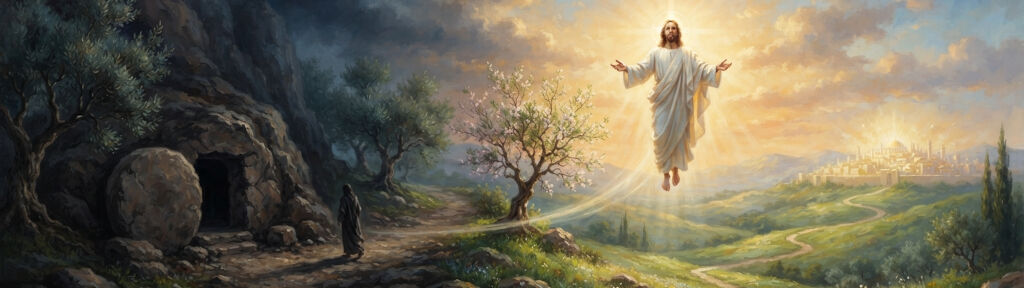
Death, Resurrection and Hope invite us to look past fear and uncertainty toward the promise of eternal life in Christ. For some time now, our first readings at Mass have been taken from the Book of Revelation, and today’s scripture calls us to reflect deeply on what comes next. Both the excerpt from Revelation (Revelation 11:4–12) and the Gospel reading from Luke (Luke 20:27–40) speak directly to our questions about the afterlife. From an early age, we all realize that natural life for every living thing eventually subsides and ceases. Emotions such as fear, anxiety, confusion, anger, frustration, and resignation often accompany our contemplation of mortality—especially when we aren’t certain what, if anything, awaits us after our last breath. You can explore more Sunday scripture reflections at sjp2.org as you prepare your heart for Mass and prayer.

Mystery of the Two Witnesses in Revelation
At first glance, today’s reading from Revelation of Death, Resurrection and Hope can seem deeply obscure. Following the image of eating the scroll, the author introduces a second digression describing two mysterious “witnesses.” Referred to as “two olive trees and the two lampstands,” they are given authority to prophesy for 1,260 days—or three and a half years—a conventional biblical period symbolizing eschatological distress.
In the Old Testament, the prophet Zechariah originally applied these titles to Joshua and Zerubbabel, the religious and civil leaders who restored the Temple and Jerusalem after the Babylonian Exile. In Revelation, they may represent the foundational leaders of the New Temple and the New Jerusalem: Peter and Paul.
The imagery that follows links these witnesses to Moses and Elijah, who represent the Law and the Prophets and appeared alongside Jesus at the Transfiguration to endorse his mission, suffering, death, and resurrection. Consider how their prophetic signs echo familiar biblical moments:
- Consuming fire: Anyone who attacks the witnesses is consumed by fire, recalling how King Ahaziah’s emissaries to Elijah were twice destroyed by fire brought down from God (2 Kings 1).
- Shutting up the sky: Their authority to halt rain echoes the severe drought that struck Israel during Elijah’s ministry (1 Kings 17).
- Plagues and blood: Their power to turn water into blood and bring other plagues recalls Moses confronting Pharaoh to bring repentance and liberation to the Israelites (Exodus 7).
Persecution, Martyrdom, and New Life
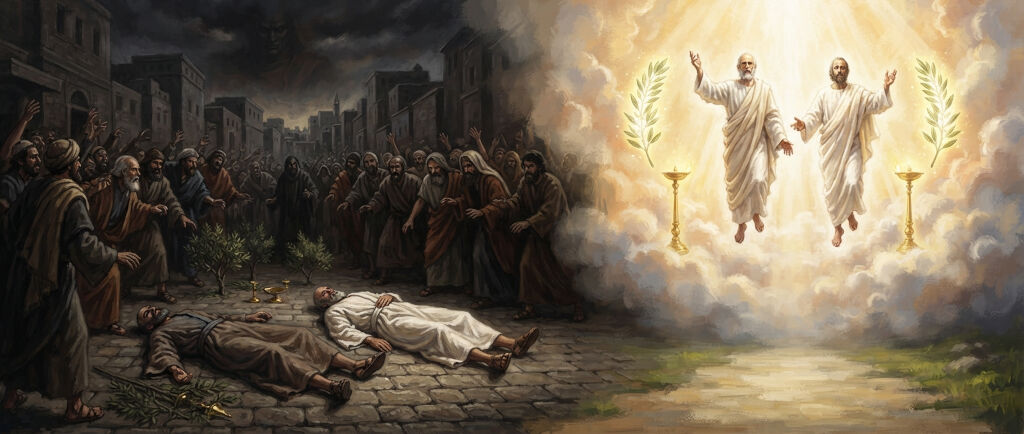
Once the witnesses complete their mission of testifying to Christ and the Gospel, a “beast” rises from the Abyss, overcomes them, and puts them to death. Pointing to the Antichrist and demonic origins, this figure represents a ruler set against God’s people—with some readers seeing an echo of Emperor Nero, traditionally linked to the martyrdoms of Peter and Paul. In this way, the fate of the prophets mirrors that of their Lord in Death, Resurrection and Hope.
The “great city” in the passage may refer either to Jerusalem or Rome. The Old Testament prophets—Isaiah, Jeremiah, and Ezekiel—sometimes call Jerusalem “Sodom” because of moral wickedness, idolatry, and oppression, and it is also the city of Jesus’ crucifixion. Yet because Judea was under Roman rule and crucifixion was a Roman execution method (whereas stoning was typical of Jewish practice), the shadow of Rome is also present—and tradition holds that both Peter and Paul died there.
The indignity continues when the “nations” forbid burial, leaving the bodies unburied for three and a half days. In the Middle East and across the Muslim world, burial typically takes place very soon after death, so leaving the dead unburied underscores the severity of the insult. Meanwhile, the “inhabitants of the earth” celebrate, viewing the prophets’ message as a torment. This fulfills Jesus’ own warning about what awaits those who preach the Gospel (Matthew 10:16–23)—a reality still seen in our own time.
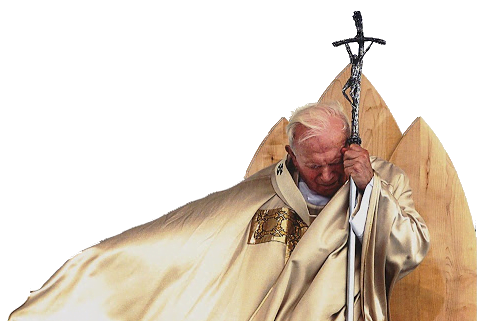
“The killing of Christians, the making of martyrs, in the whole history of the Church has only brought new life, new energy, and new courage.”
Still, death does not have the final word. After three and a half days, God grants the witnesses new life. They stand up—resurrected—terrifying those who watch, and are then called up into God’s presence in a cloud, the classic biblical sign of divine presence. Historically, Christian martyrdom has repeatedly sparked fresh faith and resolve, as seen in the 1980 assassination of Archbishop Óscar Romero while celebrating Mass in El Salvador. Time and again, the Church bears powerful witness amid persecution. For historical context on his life and ministry, see the Archbishop Óscar Romero biography on Britannica.
How Jesus Frames Death, Resurrection and Hope
Turning to the Gospel, Jesus offers concrete hope. Through God’s power, he re-infuses supernatural life into believers and even raises individuals from the dead. While Revelation points toward the ultimate reality of resurrection, Luke’s Gospel addresses what life after death is actually like.
In Luke’s account, Sadducees—who reject the resurrection—along with scribes test Jesus. Whether they acted out of hostility or simply held tightly to traditional assumptions, their legalistic question gets at a deeper human curiosity: what is existence after death really like? Jesus makes clear that resurrection life goes far beyond our current earthly frame of reference.
His response brings comfort without giving every detail. A full picture cannot be captured in earthly words alone because reality must be experienced to be truly known—much like trying to explain sensory perception to someone deprived of a sense. Rather than offering an exhaustive map, Jesus gives hope and speaks directly to the emotions stirred by mortality. When we trust his promise of death and resurrection, we can meet the future with growing anticipation and peace. You can read the full passage on the USCCB daily readings page for Luke 20 or explore foundational Catholic teaching in the Vatican Catechism on the Resurrection.
My prayer today is to ask for comfort, anticipation, and peace at the moment of my own death, and for the loved ones walking this journey of death and resurrection alongside me.
May God Bless You and Grant You His Peace!