
Discover the Letter to the Ephesians meaning as St. Paul explains the Body of Christ, holy living, and spiritual armor. Read our complete guide!
This is Part Two of the St. Paul’s Letter to the Ephesians. You can also read Part One.
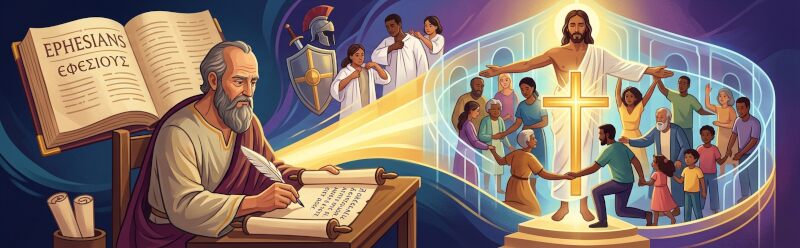
The St Paul Letter to the Ephesians offers a profound exploration into the mystery of Christ that no single theological image can fully exhaust. Throughout the New Testament, the Apostle Paul highlights distinct aspects of Jesus in each of his epistles. In Romans, he presents Christ establishing the New Covenant through His blood. In Philippians, he highlights Christ pouring Himself out in ultimate humility. However, in the Epistle to the Ephesians, Paul centers his teaching on Jesus as the supreme head of the body, which is the Church. (For more background, see the USCCB Letter to the Ephesians).
Written during Paul’s imprisonment in Rome, this foundational text demonstrates how Christ unites believers across the world to direct His divine mission. By exploring the St Paul Letter to the Ephesians, we discover how deep Christological truths directly shape daily practical conduct and spiritual growth.
The Christological Core: Christ as Head of the Body
In the opening chapters of the St Paul Letter to the Ephesians, Paul lays out a breathtaking vision of God’s eternal plan. Long before the creation of the world, God mercifully chose to send His Son to redeem humanity. A pivotal revelation in this epistle is that salvation extends beyond Israel to include the Gentiles. Christ reconciles the entire world by incorporating all believers into a single, unified body—making it possible for everyone, regardless of heritage, to be adopted into the household of God.
Even while facing physical isolation in captivity, Paul felt deeply connected to the universal Church because of Christ’s supreme authority:
“And [God the Father] has put all things under his feet and has made him the head over all things for the church that is his body, the fulness of him who fills all in all.” — Ephesians 1:22–23
Understanding this core Christological foundation clarifies why Paul gives specific moral advice. The Church, as the Church as the Body of Christ, derives its whole life and mission directly from Jesus. His directives are not merely personal opinions or Pharisaic leftovers; they flow directly from the nature of Christ Himself.
Understanding the Letter to the Ephesians meaning offers believers a powerful blueprint for authentic faith, practical morality, and spiritual growth. In St. Paul’s letter to the Ephesians, the Apostle introduces a central theological truth: Jesus Christ is the head of the Church, and all baptized believers form His living body. Having Christ as its head gives absolute unity to the Church, where every individual plays a unique yet essential role.

Paul’s development of this theme unfolds through a celebration of the rich blessings Christ bestows on His people. To understand how this calling shapes our daily spiritual walk, let us examine the core themes of unity, Christian living, and spiritual defense found in this profound epistle.
1. Unity and Maturity in the Body of Christ Ephesians
God equips the Church with diverse spiritual gifts to foster maturity and solidarity among believers. Paul explains that Christ appoints apostles, prophets, evangelists, pastors, and teachers for a specific purpose:
- Building up the Body of Christ Ephesians passage highlights.
- Achieving unity in faith and knowledge of the Son of God.
- Reaching spiritual maturity according to the full measure of Christ (Ephesians 4:12–13).
Without this maturity, spiritual growth risks being stunted by worldly distractions and childishness. Those who live in the “futility of their minds” remain darkened in understanding and alienated from God due to hard hearts.
2. Practical Instructions Living the Letter to the Ephesians
In the latter half of the epistle (Ephesians 4:25–6:24), Paul transitions from foundational theology to the daily conduct required of believers. A core aspect of Christian living Ephesians emphasizes is the necessity of personal transformation:
“Put off your old nature that belonged to your former way of life… be renewed in the spirit of your minds, and put on the new nature, created after the likeness of God in true righteousness and holiness.” (Ephesians 4:22–24)
Read out of context, these passages are sometimes misinterpreted as outdated personal opinions. However, when understood within context, Paul’s instructions are vital for authentic Christian living:
- Constructive Anger: Paul notes, “Be angry, but do not sin; do not let the sun go down on your anger” (Ephesians 4:26–27). Anger is a God-given passion meant to reject injustice, but it must remain governed by Christ to prevent the devil from taking root through grudges and resentment.
- Holy Relationships: Husbands and wives are called to mutual submission out of reverence for Christ. Husbands must love their wives selfsacrificially as Christ loved the Church, contrasting the sacrificial New Adam with the fallen Old Adam.
- Household Duties: Domestic roles—including parents, children, masters, and servants—are elevated. Christians are encouraged to work as “servants of Christ, doing the will of God from their hearts” (Ephesians 6:6–7).
To explore further commentary on Scripture and Catholic liturgical readings, you can consult resources at the USCCB Daily Readings and study early Church perspectives via New Advent Catholic Encyclopedia.
3. Standing Firm with the Armor of God Ephesians
We cannot rely solely on human strength to fulfill these high moral callings. In the final chapter, Paul presents the famous spiritual battle image known as the Armor of God Ephesians passage (Ephesians 6:11–20).
Believers are urged to clothe themselves in God’s full spiritual armor to withstand the wiles of the devil. By grounding our strength in Christ rather than ourselves, we gain the grace needed to remain steadfast against evil. For additional biblical commentary and study tools, visit the Bible Gateway Study Resources.
As excerpts from this letter are proclaimed during Mass, take time to reflect deeply on the Letter to the Ephesians meaning and let St. Paul’s inspired teachings renew your daily Christian walk.
May God Bless You and Grant You His Peace!