
Learn about applying Catholic principles to voting and public policy with guidance on conscience, prudence, and social teaching.
Yesterday, we reviewed Part I of the U.S. Catholic Conference of Bishops’ (USCCB) foundational reflection, Forming Consciences for Faithful Citizenship, which highlighted the core values governing political engagement. Today, we turn to Part II, which guides us in applying Catholic principles to voting, evaluating public policy, and fulfilling our civic duties with moral clarity.
Navigating complex political landscapes requires both an informed conscience and moral wisdom. The Church urges the faithful to listen carefully to ecclesiastical teaching, recognizing that applying church principles to civic choices isn’t just one political opinion among many—it is a vital road map for the common good.
1. Building a Well-Formed Conscience and the Virtue of Prudence
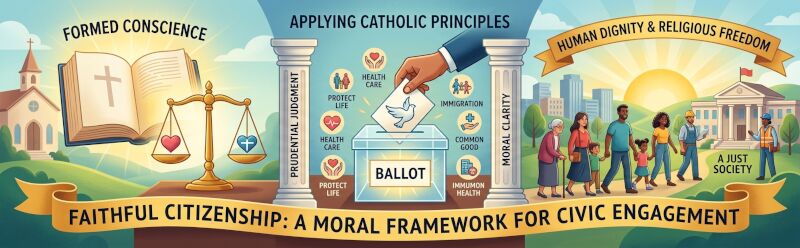
The Church equips the faithful to navigate social and political questions by prioritizing conscience formation. As the Catechism of the Catholic Church (no. 1778) explains, conscience is a judgment of reason whereby a person recognizes the moral quality of a concrete act. Catholics hold a lifelong obligation to form their consciences in light of human reason and Christ’s teachings.
Alongside a well-formed conscience, we must cultivate the virtue of prudence. Prudence enables us to discern our true good in every circumstance and select the right moral means to achieve it (CCC, no. 1806).
Key aspects of prudential discernment include:
- Deliberation: Carefully evaluating all available policy alternatives.
- Contextual Judgment: Determining what response best fits a specific situation.
- Courageous Action: Moving from ethical reflection to active civic participation.
While Catholics may sometimes disagree on the best practical strategies for solving complex social problems, we must remain united in our commitment to protect human life and dignity.
2. Opposing Intrinsic Evils While Promoting the Common Good
Certain actions are intrinsically evil because they directly contradict the love of God and neighbor. These acts can never be justified under any circumstance. Preeminent among these is the deliberate taking of innocent human life, such as through abortion, human cloning, or destructive embryo research. Other intrinsic evils include genocide, torture, racism, human trafficking, targeting noncombatants in war, treating workers as disposable, and redefining marriage.
To learn more about foundational moral teaching, consult the Catechism of the Catholic Church or read Pope St. John Paul II’s landmark encyclical Evangelium Vitae.
However, avoiding evil is only half of the equation. We also have a positive duty to build a just society. As St. John Paul II noted, negative prohibitions and positive commandments work together. The fundamental right to life implies rights to essential human needs:
- Nutritious food and clean water
- Adequate shelter and housing
- Quality healthcare and education
- Meaningful, dignifying work
3. Avoiding Two Dangerous Political Temptations
When applying Catholic principles to public life, believers must guard against two distinct ethical pitfalls:
- Moral Equivalence: Failing to make ethical distinctions between different issues. The direct, intentional destruction of innocent human life (from conception to natural death) is fundamentally different from policy disagreements on practical implementations.
- Moral Dismissiveness: Using necessary ethical distinctions as an excuse to ignore other grave threats to human dignity—such as severe poverty, environmental degradation, war crimes, religious persecution, or unjust immigration practices.
4. Making Moral Choices as Voters
The Church does not endorse candidates or tell citizens how to vote. Instead, the responsibility rests with each voter’s properly formed conscience.
When evaluating candidates and ballot initiatives, keep these principles in mind:
- Oppose Anti-Life Laws: Always oppose policies that directly violate or erode protections for innocent human life.
- Apply Prudential Judgment: Work incrementally to restore justice when morally flawed laws already exist, without ever compromising full moral protection for life.
- Avoid Single-Issue Oversimplification: While a candidate’s stance on a single intrinsic evil (like supporting legal abortion or promoting racism) may legitimately disqualify them from receiving a Catholic’s vote, no single issue alone automatically guarantees support.
For further reading on official Catholic guidance regarding civic duties, explore the USCCB Faithful Citizenship Guidelines.
5. Key Public Policy Goals for Catholic Citizens
To guide voters and public officials, the U.S. bishops emphasize key policy priorities rooted in Catholic social teaching:
- Protecting Life: Defending unborn children, assisting women in crisis pregnancies, and ending euthanasia, assisted suicide, embryonic research, and the death penalty.
- Strengthening Families & Marriage: Upholding marriage as the lifelong union of one man and one woman, promoting the complementarity of the sexes, rejecting harmful gender ideologies, and supporting parents economically and socially.
- Comprehensive Immigration Reform: Establishing fair paths to citizenship, preserving family unity, securing borders, and addressing the root causes of forced migration.
- Eradicating Poverty & Economic Injustice: Ensuring living wages, educational choice, economic assistance for the vulnerable, and fair international trade policies.
- Protecting Religious Freedom: Safeguarding full conscience rights so individuals and religious institutions can serve the common good without coercion.
- Healthcare Access: Providing universal healthcare while respecting human dignity, life, and religious liberties.
- Peace & Just Foreign Policy: Adhering to strict moral limits on military force, ending religious persecution worldwide, and caring for God’s creation.
Conclusion
By applying Catholic principles to civic life, voters can help foster a renewed politics grounded in human dignity, justice, and solidarity. Political engagement guided by a well-formed conscience reflects the very best of Church teaching and the highest ideals of democratic citizenship.
May God Bless You and Grant You His Peace!