Today we have our last selection of readings from Proverbs (Proverbs 30:5-9). We are urged to take refuge in the unalloyed or flawless word of God, which will be our most effective security in life. When we fully assimilate that word, we are endowed with a vision of life that enables us to see where real truth and goodness lie.
The Devil Can Cite Scripture For His Purpose
At the same time, we are not to play around with God’s word, to distort it to suit our own convenience. Moses gave a similar warning to the Israelites (Deuteronomy 4:2). It is something we can very easily do, especially when we take a text out of its context as some people, including preachers, tend to do. As Shakespeare wrote, “The devil can cite Scripture for his purpose”. It is not at all difficult for us to do the same.
The reading ends with a prayer to God for two things: “Put falsehood and lying far from me.” The writer asks for the gift of integrity. The author desires wholeness, where there is perfect harmony between his inner self and his outward behavior, and between God’s will and the deepest desires of his heart. Putting this request in New Testament language, Jesus said: “Blessed are the pure in heart, for they will see God” (Matthew 5:8).
The Proverbs author also prays for basic security in life, that he be supplied with his essential needs. We, too, pray for this when we say the Lord’s Prayer: “Give us each day our daily bread…” He wants neither wealth nor destitution. Both have their dangers. Wealth can alienate one from God. In the arrogance of wealth, I may be tempted to say, “God? Who is he? What has he got to do with me? I don’t need him.” We remember the parable of the rich fool with his full barns (Luke 12:13-21). Moses predicted that Israel would forget God when their food was plentiful and their herds large (Deuteronomy 8:12-17). The ever-growing prosperity of western society has led to a parallel growth in secularism.
Destitution, on the other hand, can lead to our using criminal means to survive. In our day of great material prosperity coupled with enormous areas of destitution and poverty, the Christian community can give formidable witness by repudiating the consumerist, hedonistic mentality through living a life of decent simplicity. We also need to work hard to bring about a more equitable sharing of the vast wealth that parts of our world are generating.
This was originally the purpose of religious life, and it is still the ideal, but it is not often as visible in the lives of religious as it could be. This is partly because some religious themselves are not immune to the consumerist ‘bug’, but also because the normally simple lifestyle of the majority of religious is not seen enough by people.
In our day, lay people too can give this witness of simplicity, living according to one’s needs. A good definition of a person who is really rich: one whose needs are the least.
ST PIUS OF PIETRELCINA
(Padre Pio) 1887-1968
St. Padre Pio was born Francesco Forgione, on May 25, 1887, in Pietrelcina, Italy. His parents were peasant farmers. He had an older brother and three younger sisters, as well as two other siblings who died in infancy. As a child, he was very religious and by the age of five he reportedly made the decision to dedicate his life to God.
Even as a child, Francisco had a peculiar ability to see guardian angels and he spoke frequently with Jesus and the Virgin Mary. He assumed other people could see and hear them too.
Although Francisco and his family were very religious, they were also very poor, which required that he work. He spent many years as a child tending to a small flock of sheep owned by his family. Unfortunately, the work meant he was unable to attend school regularly, so he quickly fell behind other kids his age. Francisco also was sickly as a child. He suffered an attack of gastroenteritis at age six and when he was ten, he had typhoid fever.
In 1897, after three years of schooling, Francisco expressed to his parents that he wanted to become a friar. His parents traveled to a nearby community of monks and asked if Francesco could join them. He was evaluated, despite his young age, and was told that he needed more education before he could join. To prepare Francesco, his parents hired a private tutor. To pay the cost, Francesco’s father traveled to America to find work and sent the money home.
At the age of 15, Francisco was finally ready, and he entered the novitiate of the Capuchin friars at Morcone. He took the name of “Pio” in honor of Pope Pius I, whose relic he often saw at his local chapel. At the age of 17, Brother Pio became extremely ill to the point he could only digest milk and cheese. He was sent to the mountains for better air, and when this did not work, he ultimately was sent home to his family.
Amid this, he continued his studies for the priesthood. On one occasion during prayer, a fellow monk astonishingly reported that he witnessed Pio levitate during an episode of ecstasy. Brother Pio became a priest in 1910 but was permitted to remain at home because of his poor health.
Padre Pio was summoned for military service in 1912. He was compelled to leave a tiny community of monks, with whom he was then housed, and was drafted into medical service. However, he was so sickly that he was often sent home, only to then be recalled for service. In March 1916, he was finally dismissed because of his poor health.
On September 20, 1916, Padre Pio was hearing confessions when he felt pain in his hands and feet. He noticed the stigmata, the wounds of Christ, appearing on his hands and feet. The experience was painful. Bleeding occurred. The wounds smelled of roses, and although they continued to weep, they never became infected.
His popularity became a source of concern
By 1919, word began to spread about Padre Pio’s stigmata and people came from far away to examine him. Padre Pio became popular with the people he encountered who soon began to attribute supernatural occurrences to him. He was said to be able to levitate, he could bi-locate (be two places simultaneously) and was able to perform other miracles.
His popularity became a source of concern for the Church, and the Vatican began to restrict his activities to minimize public interaction. Padre Pio himself was uncomfortable with his newfound popularity and the attention he received because of his stigmata. A Church investigation concluded that his stigmata were not faked. By 1934, the Vatican began to change its attitude towards Padre Pio, and he was again allowed to perform public duties.
Near the end of World War II, a curious young man serving in the U.S. Army Air Corps in Italy went to meet Padre Pio. He was fascinated by the simple Friar, and with a few friends made several more trips to visit Padre Pio. The young man later related that Padre Pio loved to smoke and loved having the Americans visit him because Americans always had cigarettes, “the very best” he said. After the war, the young man returned to the United States, married, and had four children. This man was my father, John W. Rees.
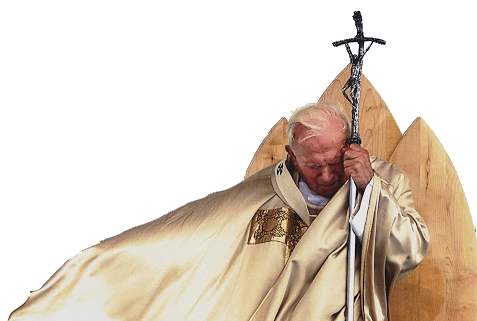
Another famous visitor, in 1947, was Fr. Karol Wojtyla. Padre Pio prophetically told him he would rise to the highest post in the Church. Fr. Karol Wojtyla later became Pope John Paul II in 1978.
Padre Pio became internationally famous. He was known for his piety, charity, and the quality of his preaching. He famously advised, “Pray, hope and don’t worry.”
Padre Pio died on September 23, 1968. His funeral was attended by over 100,000 people.
Pope John Paul II canonized St. Pius of Pietrelcina (Padre Pio) on June 16, 2002. His feast is September 23. He is the patron of civil defense volunteers, adolescents, and the village of Pietrelcina.
May God Bless You and Grant You His Peace!