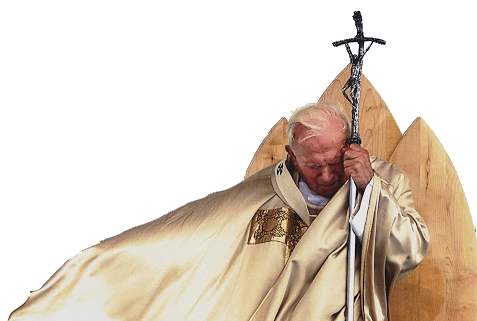

(Pope October 16, 1978-April 2, 2005)
Karol Józef Wojtyła was born on May 18, 1920, in Wadowice, Poland, the youngest of three children. Although he was born into a loving family, his early life was marked by suffering and loss. His older sister, Olga, died in infancy and, by the time Karol was twelve, his mother Emelia had died of kidney failure and his older brother, Edmund, had died heroically serving those stricken with scarlet fever.
Karol attended Kraków’s Jagiellonian University in 1938 where he studied Polish language, literature, theater, and poetry. His studies were interrupted when Nazi Germany invaded Poland in September 1939. To remain in the country, Karol was forced to work in a stone quarry as well as night shifts at the Solvay chemical plant. Karol joined a clandestine seminary headed by Cardinal Sapieha and was ordained, alone, on the Feast of All Saints in 1946. He then traveled to Rome to continue his doctoral studies. Upon his return to Poland, he was made assistant pastor of a parish in Niegowic, where he began his vital work with young people.
After teaching in the Jagiellonian University for approximately five years and having been appointed to the Chair of Ethics at the Catholic University of Lublin, Fr. Wojtyła was consecrated auxiliary bishop of Kraków on July 4, 1958 – the youngest bishop in the history of Poland. Bishop Wojtyła encouraged a spiritual and cultural resistance to the Communist occupation of Poland, giving his countrymen hope in the face of grave oppression.
Bishop Wojtyła attended the Second Vatican Council beginning in 1962, where he provided a vital support to the seminal documents of the Council. His insight and gifts were also central in the final formulation of Humanae Vitae, which was promulgated by Pope Paul VI in 1968. Soon after, he was elevated to the College of Cardinals.
After the sudden and unexpected death of Pope John Paul I, Cardinal Wojtyła was elected Pope on October 16, 1978, and took the name John Paul II. If Pope John Paul I had one of the shortest pontificates (a mere 33 days—see yesterday’s Daily Reflection), Pope John Paul II was to have one of the longest pontificates in the history of the Church, lasting nearly 27 years.
John Paul II went out to the world with a vigorous missionary spirit. He embarked on 104 apostolic journeys to 129 different countries, “to the uttermost parts of the earth” (Acts 13:47), beginning with the West, Mexico and the United States. His love for young people led him to establish World Youth Day, celebrated 19 times during his pontificate, which attracted millions of young people from all over the world. The Pope’s concern for marriage and the family was clearly expressed in the establishment of the World Meeting of Families, his Wednesday catechesis on human love, and the founding of the Pontifical John Paul II Institute for Studies on Marriage and Family.
On May 13, 1981, Pope John Paul II was the victim of an attempted assassination in St. Peter’s Square. Shocking the world, he exhibited extraordinary love and forgiveness when he made a personal visit to his attacker, Ali Agca, in Rebibbia Prison in 1983. Following his recovery, Pope John Paul II continued with his missionary activity, meeting with more than 17,600,000 pilgrims during General Audiences and countless millions of faithful during his subsequent pastoral visits throughout the world. He continued to meet with numerous government leaders during 38 official visits and 738 audiences and meetings held with heads of state, including two landmark speeches at the United Nations and 246 audiences with prime ministers.
St. John Paul II was a prolific writer. His writings included 14 encyclicals, 15 apostolic exhortations, 11 apostolic constitutions and 45 apostolic letters in addition to the catecheses delivered to the general audiences, lectures and homilies given during his many travels. With his emphasis on the universal call to holiness, he beatified 1,338 people and canonized 482 saints, more than all of the popes in the last 500 years combined.
Throughout his pontificate, Pope John Paul II guided and prepared the Church to celebrate the Great Jubilee Year (2000), a celebration of the mercy of God and the forgiveness of sin, which began with the opening of the Holy Door of St. Peter’s Basilica. Eight million pilgrims came to Rome to pray during the Great Jubilee Year. During this time, Pope John Paul II prayed for God’s forgiveness and for the forgiveness of those wounded by the sins of Christians throughout the past two millennia. With the Year of the Redemption (1983), the Marian Year (1987), and the Year of the Eucharist (2004-2005), he devoted himself to the spiritual renewal of the Church.
John Paul II successfully encouraged dialogue with Jews and inaugurated a time of healing between Jews, Muslims, and representatives of other religions. Several times he extended an invitation for these groups to participate in worldwide meetings to pray for peace.
Suffering from the debilitating effects of Parkinson’s disease, the aftereffects of the wounds from the attempted assassination, multiple surgeries, and the loss of his voice, Pope John Paul II expressed in his last days the mystery of the Crucified Lord. With hundreds of thousands of young people beneath the window of the papal apartment keeping candlelight vigil during the pope’s final agony, Pope John Paul II died during the first vespers of Divine Mercy Sunday, April 2, 2005. More than three million pilgrims traveled to Rome to pay homage to the pope, some standing in line for over 24 hours to pray in thanksgiving for their beloved Holy Father.
On April 28, 2005, his successor, Pope Benedict XVI (more on him tomorrow) announced that the normal five-year waiting period before beginning the cause of beatification and canonization would be waived for John Paul II. On May 1, 2011, Pope Benedict XVI beatified Pope John Paul II, and Pope Francis canonized Saint John Paul II, alongside Saint John XXIII, on April 27, 2014. His feast day is October 22.
May God Bless You and Grant You His Peace!