
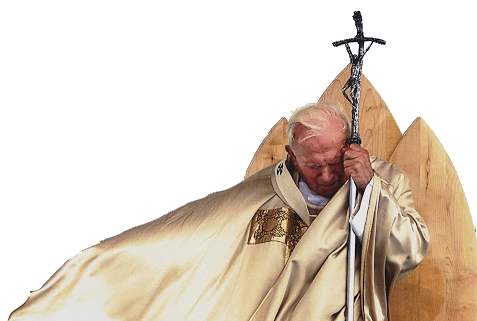

In the Roman Catholic Church, Easter has always been a celebration of the great love that God has for His creation. This great love was shown when the Divine Son became incarnate and dwelt among us, sharing in our lot, showing us the way to the Father, and making the perfect offering of Himself in atonement for our sins. Today, the second Sunday of Easter, the Church remembers explicitly and celebrates that Jesus is the fulfillment of God’s love for the world.
The first epistle of St. John declares to the entire world that “God is love;” and in his encyclical letter Rich in Mercy, St. John Paul II wrote, “Mercy is love’s second name.” This Biblically formulated relationship between love and mercy is expressed by St. Faustina Kowalska when she says: “Love is the flower; mercy is the fruit.”
St. Faustina’s diary details Christ revelations to her, largely focusing on His message of mercy. She wrote that she first saw a vision of Jesus on February 22, 1931. He had rays of mercy streaming from His heart. Christ told her to have an image painted to represent the vision and to write below it, “Jesus, I trust in you!” St. Faustina died of tuberculosis in 1938 at age 33.
St. John Paul II canonized her in 2000 and declared the Sunday after Easter as Divine Mercy Sunday, a worldwide feast day. Two years later, he instituted a plenary indulgence for those who participate in the devotion. St. John Paul II was himself canonized on the feast of Divine Mercy in 2014 (April 27, 2014).
In extending this feast to the entire Church, St. John Paul II re-emphasized the resurrection context of Easter, citing St. Faustina’s diary: “Humanity will never find peace until it turns with trust to Divine Mercy.” In describing this feast, St. John Paul II says: “Divine Mercy! This is the Easter gift that the Church receives from the risen Christ, a gift which it offers to all humanity.”
In speaking about the revelations to St. Faustina and in declaring the feast day, St. John Paul II made one point abundantly clear: This is not a new revelation. The Church has always been aware of God’s loving mercy for us, and Jesus has always been seen as the living embodiment of that mercy.
There are many people who have a special devotion to the Divine Mercy, following the practice begun by St. Faustina. There are numerous websites related to the Divine Mercy, and there are national and international conferences held in conjunction with this feast. There is a Divine Mercy chaplet, which is prayed like the rosary, and a Divine Mercy novena, which is prayed for the nine days prior to the feast.
All of these celebrations and prayers are designed to help us remember and reflect upon the mercy that God has shown us in our lives, especially in giving us his only Son for our salvation.
St. Faustina’s visions and the feast serve the purpose of focusing our attention on this fact and encouraging us to remember God’s great love for us. The feast day serves as a clarion call for us to hear and believe the good news and to intentionally turn to God to accept the divine mercy that is always being offered to us.
Divine Mercy is the form that God’s eternal love takes when He reaches out to us in the midst of our misery and our brokenness. Whatever the nature of our need might be — sin, guilt, suffering, or death — He is always ready to pour out His merciful, compassionate love for us, to help us. Where there was only despair, loneliness, and heartache before, comes joy, fruitfulness, and abiding love.
The message of Divine Mercy is simple. It is that God loves us and wants us to approach Him in constant prayer, repenting of our sins while asking Him to pour His mercy out upon us and upon the whole world. He wants us to receive His mercy and let it flow through us to others, extending our love and forgiveness to others just as He does to us.
We must realize that God does not do anything in portions. He is infinite and the amount of His Divine Mercy available to us is infinite. The only limiting factor is us. The more we trust in Jesus, the more graces we will receive and the more all will come to share His joy. This is the message Jesus is giving us through today’s devotion to his Divine Mercy, a mercy that he tells us is unfathomable and which he wants us to spread throughout the world through our own actions and love for others.
May God Bless You and Grant You His Peace!